Smart mowers hit fairways

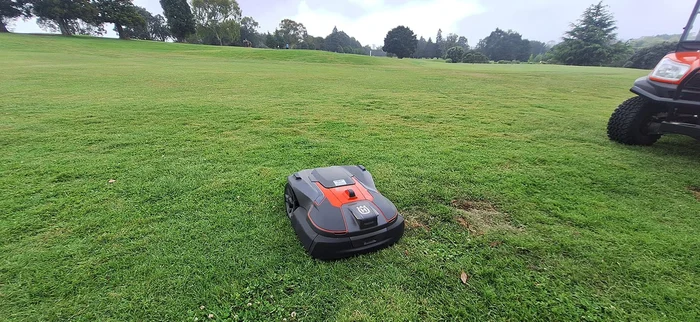
SAFETY FIRST: Greenkeeper Steven Edwards tests the autostop safety feature of the CEORA. Photos Rufus DempseyE6209-01
Rufus Dempsey
Three new robotic mowers are now at work at Ōpōtiki Golf Club, promising significant savings in fuel and maintenance, while giving greenkeeper Steven Edwards more time to focus on keeping the course in top condition.
The Husqvarna machines are the centrepiece of the club’s SmartMow Sustainability Initiative, supported by Trust Horizon funding, which aims to reduce the club’s environmental footprint, while improving the quality and efficiency of course maintenance.
The club has invested in three autonomous electric mowers to maintain the fairways, roughs and areas around the clubhouse, leaving Edwards to concentrate on the finer details of course presentation and keeping the greens in tip-top condition.
Edwards has worked as a greenkeeper since leaving school, beginning his career in the United Kingdom before bringing his skills to New Zealand, where he worked at Tūrangi Golf Course before taking responsibility for the Ōpōtiki course.
Although initially sceptical about the technology, Edwards said club president Ngawai Amoamo persuaded him to watch a demonstration – and it did not take long for him to be convinced.
“I was initially a bit sceptical of the new technology. I am a bit of a traditionalist and have gotten used to the rewarding feeling of doing everything manually,” he said.
“However, after Ngawai talked me into getting a demonstration I was sold after about an hour of watching them in action.”
Edwards said the machines would take a considerable amount of the workload off his shoulders while offering environmental and financial benefits.
“The mowers take away so much of the hassle of the job, are more sustainable and environmentally friendly and do a great job, allowing me to focus on the details and keep the club and the greens as presentable as possible,” he said.
The potential fuel savings are particularly significant, with Edwards estimating the club previously used up to 70 litres of diesel a week mowing the course.
“With the cost of diesel the mowers will be a huge saving over time,” he said.
“We can use up to 70 litres of diesel a week mowing the course before, whereas the three mowers only use about $50 per month in electricity to charge.”
The commercial machines use GPS-enabled technology, allowing Edwards to monitor and control their operation from his phone and receive notifications if any issues arise around the course.
He said he was already seeing a difference in the quality of the fairways and expected the improvements to help lift the standard of the course and attract more visitors.
The equipment includes Husqvarna’s CEORA robotic mowing system and 580L EPOS technology, designed for professional grounds maintenance.
The system uses satellite positioning to guide mowing within digitally defined work areas, reducing the need for traditional boundary wires.
Helping bring the system to life at Ōpōtiki was Hayden Skinner from Mowers and Chainsaws Whakatāne, who supplied the equipment and assisted with its installation, alongside Sam Jasper from Husqvarna New Zealand.
Skinner said a similar system had already been installed at Ōhope Golf Club, where it had been well received.
“The progression in technology for the automated mowers has happened so fast; they just keep getting better with every model, and the time saved allows the greenkeepers more time to focus on the details of the course instead of sitting on a mower for hours,” he said.
The commercial machines can cover substantial areas, with the Ōpōtiki equipment operating within a mowing area of up to 25-kilometres in total route capacity, depending on the model and configuration.
Skinner said the Husqvarna range included about 24 models, with around five new models expected to be released this year. Domestic models generally started at about $1300, while advanced commercial machines could cost up to $67,000.
Newer models were also incorporating cameras and artificial intelligence-based grass validation technology.
Jasper said Husqvarna’s golf course installations were proving successful around the country.
“We set up the system for the first golf club in 2024, and have done about 15 different clubs all round the country so far, and all have been very successful,” he said.
For Ōpōtiki Golf Club, the investment is part of a wider commitment to sustainability and improving the experience for members and visitors.
The 18-hole, par-70 course on Fromow Road has been a fixture in the community for more than a century, and the SmartMow project is intended to help secure its future by reducing operating costs and making better use of staff and volunteer time.
The funding application was supported by letters from Te Pou Oranga o Te Whakatōhea Taiao manager Logan Bertram, Ōpōtiki Primary School principal Tony Howe, club life member and long-serving greens committee volunteer Bruce Hawtin, and neighbouring resident and club member Raymond Shove.
Their support highlighted the project’s potential environmental, educational, volunteer and wider community benefits, reinforcing the club’s role as more than simply a place to play golf.
With the new machines now operating, Edwards said he was looking forward to seeing the improvements continue as the club makes the most of the technology.
He hopes the better-maintained fairways and more efficient course management will help raise the profile of Ōpōtiki Golf Club and encourage more people to come and enjoy a round.