Whakatōhea taonga journey takes Ōpōtiki to Los Angeles

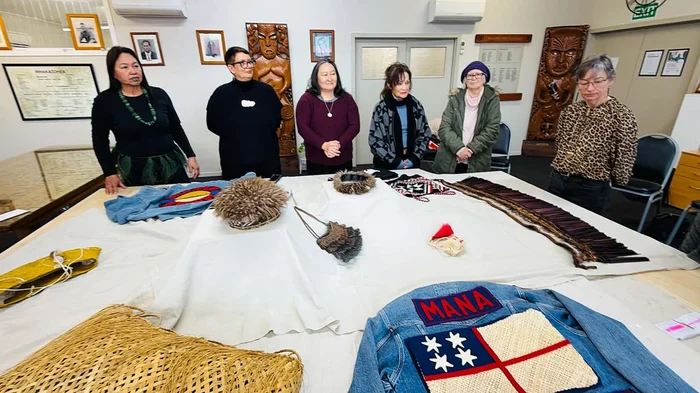
SIGNIFICANT JOURNEY: Tangimore Clay, bottom right, with some of the 27-strong delegation heading to Los Angeles. Photos supplied
Rufus Dempsey
A delegation of 27 Whakatōhea will leave from Ōpōtiki this week for a significant journey of reconnection, taking them to Los Angeles and a collection of taonga held more than 10,000 kilometres from home.
Among the delegation will be renowned Ōpōtiki weaver and artist Tangimoe Clay, who will join Whakatōhea kaumātua, artists and representatives for the opening of Taonga Tuku Iho: Ancestral Gifts and Contemporary Māori Art at the Fowler Museum at UCLA.
The exhibition has its origins in a historic kaitaka held in the Fowler Museum collection, believed to have belonged to a Whakatōhea chief from Ōpōtiki.
A cloak that was gifted to the museum more than 65 years ago as part of the Sir Henry Wellcome Collection, and its connection to Whakatōhea, has been the focus of research and relationship-building in recent years.
Whakatōhea representatives visited the museum in 2024, beginning a process of reconnecting the taonga with the people and whakapapa from which it came.
The resulting exhibition brings the historic kaitaka together with contemporary works by Whakatōhea artists, creating a dialogue between ancestral knowledge and contemporary Māori creativity.
Clay has a particularly close connection to the exhibition. Her handwoven poi tāniko, Whaiao ki te ao Mārama, has been gifted to the Fowler Museum as a companion to the kaitaka and will remain with the cloak indefinitely, whether it is being exhibited or stored.
Clay said she was thrilled by the level of interest in the kaupapa and the willingness of people to support the journey, particularly given the delegation is self-funded.
“I was thrilled that they even were interested and believed in the kaupapa, and that’s the power of the kaupapa when you’re self-funded,” she said.
“That’s when you truly sort out who’s on for the ride and who’s really backing the kaupapa and it’s run so smoothly. I’m very grateful because it’s very hard to move our kaumātua. So it’s a pilgrimage for us.”
For Clay, the journey is also part of a wider conversation about the future of taonga held overseas and the relationships they have developed with the places and people who have cared for them.
“At this time, until Whakatōhea has built its own whare taonga, we do not have the facilities,” she said.
“So, to think about repatriating her to where? You know, to another iwi, to another museum? Until she’s ready to come to our museum, they’ve done all right looking after her.”
The exhibition also represents a new approach to how cultural artworks and taonga held overseas are understood and cared for.
The Whakatōhea relationship with the Fowler Museum has included the application of Traditional Knowledge Labels to the collection – described by Creative Commons as the first time the system has been used in an overseas collection.
Clay said the development represented an important step for Whakatōhea and other iwi seeking to reconnect with taonga held around the world.
“This is a very new thing that’s happening now and I’m very grateful that our iwi is leading the way on taonga that is overseas,” she said.
“It’s really cool and I think the message is probably about our taonga belonging to us and us believing that it belongs to us rather than we can never get it back.”
She said the kaupapa was about more than simply bringing taonga home.
“It’s not even about just getting it back. It’s about those pieces creating their own journey and they’ve travelled sometimes to three or four countries,” she said.
“So, they have created, in the living sense, their own whakapapa around the world and we’re just going to come in and awhi that whole space for them whether returning or staying.”
For the 27 members of the delegation, however, the journey is about more than an international exhibition.
For Clay, the distance between Ōpōtiki and Los Angeles is no longer the barrier it may once have seemed.
“The world is only small now, LA is just over there. It’s only a plane away from us. Our taonga are just a plane away,” she said.
The trip will provide an opportunity for the delegation to stand before taonga that have travelled far from home, reconnect them with their whakapapa and share the kōrero and knowledge that will help carry those connections forward for future generations.
The exhibition’s opening programme will be held on October 10, with artists’ perspectives, cultural presentations and opportunities for community engagement before the exhibition opens to the public the following day.