
Opinion: Cost-of-living impacts the elderly

.
■ There was no need to be a clairvoyant to figure out that the Hamas breakout from Gaza on October 7, 2023, was likely to result in serious and widespread conflict in the Middle East, which would affect oil flows.
And yet,the mainstream media was remarkably silent despite the
experience of 1970s oil shocks, writes Whakatāne District Grey Power
Association president Victor Luca

As it stands, things are looking considerably worse than back then.
Since the unprovoked Israeli and the US attack on Iran on February 28 2026, the passage of oil through the Strait of Hormuz has been reduced significantly.
To add insult to injury, in recent weeks the Bab al Mandeb Strait has been virtually closed by Ansar Allah (aka the Houthis) following an unprovoked attack by Saudi Arabia on the Yemen.
Aside from blockage of oil transit choke points, fighting is also destroying or damaging oil and refinery infrastructure, which is going to continue to put pressure on the supply of refined products like gasoline, jet fuel, and diesel.
Ukrainian drone attacks on Russian oil refining infrastructure may be exacerbating the squeeze on diesel supplies in particular, although Russia produces only about 6.5 percent of world diesel.
The average New Zealand diesel price has now breached $3 per litre, as it has in the United States, and it is likely to continue the upward trend as hostilities escalate.
That is almost twice what diesel cost in New Zealand in 2020 and almost three times what it cost in the US. All this makes for a very ugly panorama.
As I have been asserting since early 2024, diesel is particularly problematic for countries like New Zealand that produce no diesel and depend almost entirely on diesel trucks for the transportation of goods.
An increase in transport costs invariably results in increased prices. The last reading of CPI inflation issued by Treasury was 4.2 percent and the trend is clearly going to be higher.
Unfortunately, unlike Australia which reports CPI numbers monthly, NZ reports CPI only quarterly.
While we are all going to be buffeted by the chaos in the Middle East, it is elderly folk on fixed incomes that are likely to be among the hardest hit.
In a Stuff article “Here’s why everyone (even high earners) feels broke in NZ right now” dated August 7, 2026, one of our better known economists, Shamubeel Eaqub, noted that the main inflation culprits were fuel, electricity and council rates.
During the development of the 2024 LTP I was persistent in asking the question of affordability and what it really means, particularly for older folk. It was a debate that few seemed to want to have.
I included some of my thinking in a February 2024 Beacon op-ed “Hunker down or spend more”.
In that article I carried out an analysis of the rate of increase in council rates compared to the rate of increase in pensions. I had this idea that council rates had consistently increased more than pensions.
What I found after a bit of research was more nuanced than I had originally thought.
Once I worked the numbers I found that pension increases were roughly keeping pace with the increase in council rates between about 2011 and 2023. I had projected that would not be the case if the LTP2024-2034 LTP was passed.
Now that the numbers are actually in, it’s worth re-considering that analysis.
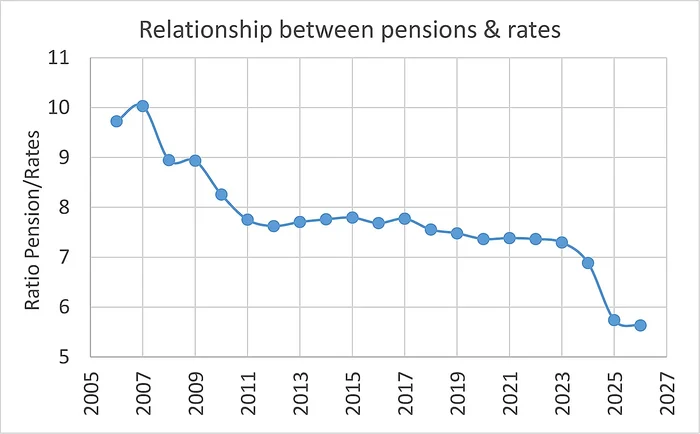
In the graph above, I plot the ratio of a single living-alone pension to council rates In the graph above, I plot the ratio of a single living-alone pension to council rates on the property in which I live.
The council rates value used in the pension-to-rates ratio includes Whakatāne District Council and Bay of Plenty Regional Council (BOPRC) but not water rates.
The larger the pension-to-rates ratio, the better off a person is.
The spike in the pension-to-rates ratio in 2007 is followed by a drop over the next four years and then a plateau or gradual descent from 2011 and 2022.
From 2023 onward the pension-to-rates ratio has plummeted, which is the point I was trying to make in my original article.
The numbers I present are for my own situation and everyone’s situation will, of course, be different.
Folk can do their own numbers easily by accessing historical council rates on their property from the online rates calculator.
Type “Whakatāne and rates property search” into your browser or the following URL:
https://www.whakatane.govt.nz/residents/rates/rates-property-search
Please remember, however, that BOPRC rates were separated out in 2022.
Historical pension amounts that I use are pre-tax.
These numbers can be easily obtained from the internet through a series of Google queries.
The bottom line is that pension-to-rates ratios have dropped to unprecedented low levels from 2023 and the trend is clearly downward.
While this may be tolerable for folk who have other income sources, those whose only income is their pension are going to find it tough going.
Add rising inflation into the mix, possible future devaluation of the US dollar, and a council that is seemingly unable to pull its head in, and things are set to become very difficult going forward, especially for pensioners on fixed incomes.
The pressure on living costs is likely to reach unprecedented levels if geopolitical tensions don’t subside and economic conditions improve.
My guess is that this will not happen any time soon.
On Wednesday, October 21, Grey Power will be holding a “Meet the candidates” event at the Liberty Centre starting at 10am.
All candidates for the East Cape general electorate have agreed to attend, except for Dana Kirkpatrick, who is otherwise engaged.
This might be a good time to come and hear what the candidates have to say on cost-of-living, health and other matters.
All are welcome to attend.
Meet the candidates East Cape general electorate
■ Where: Liberty Centre
■ When: Wednesday, October 21, 10am