
Opinion: Rethinking tax – a call for fairness in NZ’s tax system

.
■ Tim Senior – Firstly, a disclaimer: I am certainly not a tax expert or an economist, but I am a taxpayer and a superannuitant. What follows are my own views with some expert opinion and official statistics thrown in.
This year’s election campaign seems to be all about tax. Each political party has come up with their very different tax policies.
Contrary to what some politicians would have us believe, New Zealand is not a highly taxed country.
Of the OECD group of countries, 26 mostly European countries have a higher tax revenue as a percentage of their GDP and only 11 have a lower ratio.
Tax is the way that all of us pool our collective resources to pay for things that help us to live good lives and which we wouldn’t be able to pay for individually.
We should all have access to a great education and training system, healthy homes, fully staffed modern hospitals, an efficient transport system and a flourishing natural environment, to name but a few.
Currently, we don’t all have access to all these things. Every day we hear about a health system in crisis, crumbling infrastructure, rocketing superannuation costs etc etc etc.
Perhaps the worst statistic of all is that in early 2026, 14.3 percent of all children, 169,300 of them, lived in material hardship.
And that’s 47,500 more since 2022. Even worse for our district is that 25.1 percent of these kids are Māori.
Just over half of the nation’s tax revenue comes from what we commonly call “income tax”.
I prefer to call this salary and wages tax because it doesn’t include the income some people derive from other sources, such as selling assets (capital gains).
This means that the wealthiest 311 families contribute 9 cents tax per $1 earned. The average wage and salary earner pays 20c per $1 earned.
In other words, we tax work more than wealth. Fair?
Many of us would agree that some corporations (for example banks, gentailers and supermarkets, make excess profits.
Some international companies (such as Google and Facebook) pay almost no tax despite the huge income they generate from us. Fair?
And inequality grows. The collective wealth of the ultra-rich has grown from $5.3 billion in the 1980s to $129 billion in 2025.
Meanwhile, over the same period, child poverty has tripled from 8 percent to 14.3 percent. Fair?
Polls show that 83 percent of us support increased spending on key public services and a majority of people support wealthier people paying more tax (and ironically some of those wealthy people themselves have said that they should pay more tax). But it seems politicians aren’t listening.
So, what are we to do?
We could re-prioritise a few dollars here and there. Or we could fiddle around with a few minor tax changes.
The other alternative is that we could completely overhaul the tax system to pay for what we need in a more equitable way, and in doing so, bring us more in line with countries that do a much better job of covering their costs.
Almost all developed economies have a capital gains tax or a wealth tax of some sort, not to mention a host of other taxes, and so people generally pay much less income tax than we do.
It seems to me that we need to ensure that the wealthiest people and some large companies pay their fair share.
Some solutions to create a fairer system may be:
n To tax wealth not just work. Almost all other developed countries do this by means of one or more of capital gains tax, wealth tax, inheritance tax, property transfer tax or financial transaction tax. To lower, or remove, income tax for those least able to afford it.
n To reign in excessive corporate profits with tax and a banking levy.
n To enforce the tax obligations of tax multinational corporations.
n To increase the cost of harmful corporate behaviour, such as tobacco excise and mining royalties.
Some international comparisons may be useful.
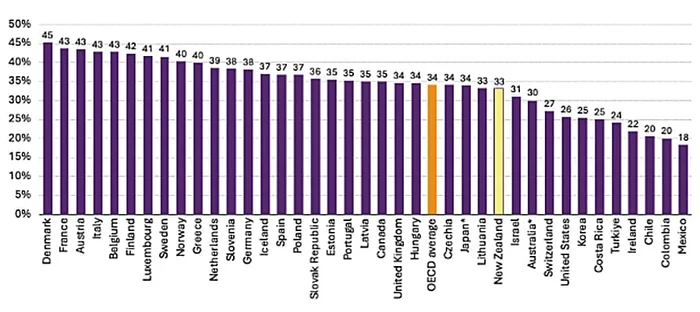
The graph above shows that our tax revenue as a percentage of GDP is a little below the OECD average at 32.9 percent.
But more significantly, 26 countries (almost all of Europe, Canada and Japan) have a higher ratio, while only 11 have a lower ratio.
Denmark, a country with a similar population to ours and by all accounts a very pleasant place to live has the highest ratio at 45 percent.
Contrary to what some politicians would have us believe, New Zealand is a relatively low tax country.
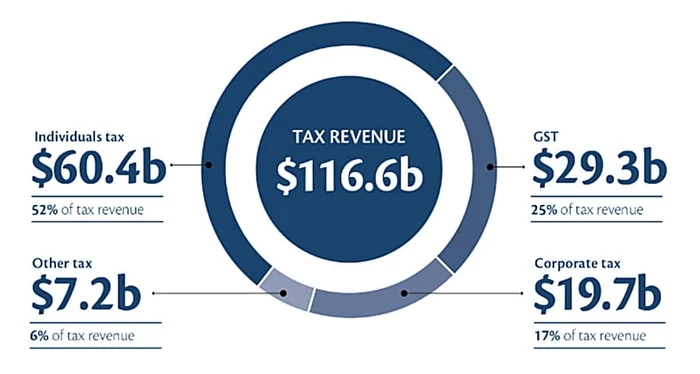
The image above shows the sources of tax revenue in New Zealand. Note that 52 percent comes from income tax (individuals’ tax) and “other taxes” make up just 6 percent.
These ratios are very different in other countries.
In the UK, 28 percent of tax revenue comes from “other taxes” of which there are many.