
Ōpōtiki academic takes indigenous education to world stage
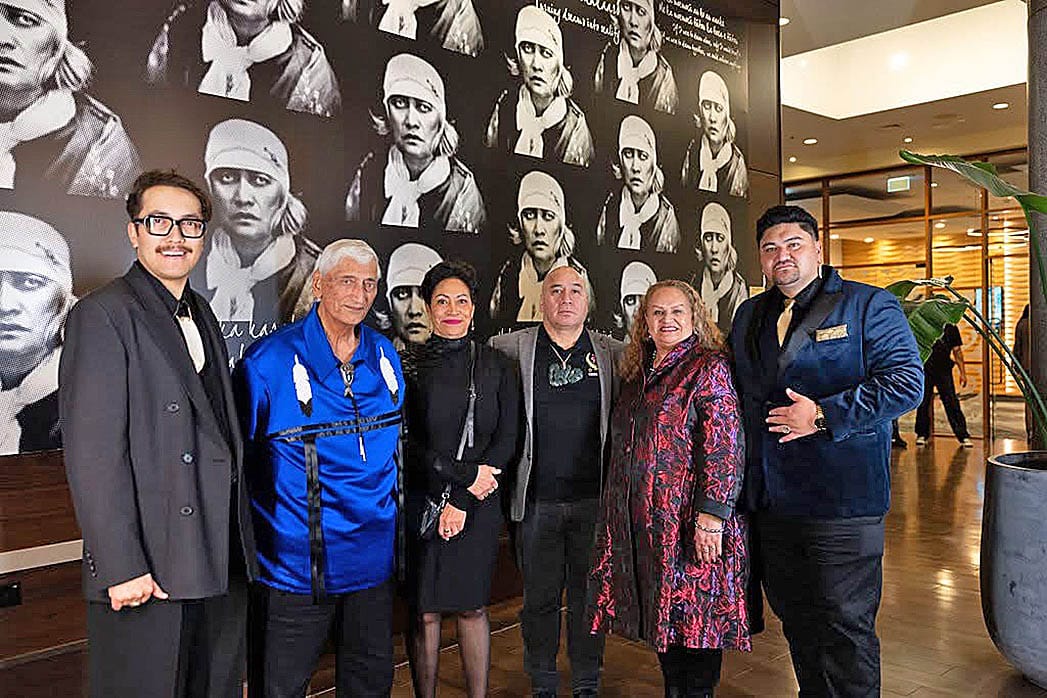
HANDOVER: (From left) Jaye Wainui, newly appointed Aotearoa representative; Dr Rongo Wetere, WIPCE Aotearoa 2005; Aroha Te Kanawa, WIPCE International Council secretary; Dr Bentham Ohia, WIPCE Aotearoa 2005; Professor Tania Ka’ai, Te Ipukarea, Auckland University of Technology; and Dr Toiroa Williams, newly appointed Aotearoa representative, at the Matariki reception in Kirikiriroa, Hamilton, marking the official handover of Aotearoa’s WIPCE International Council representatives. Photo supplied
Tamara Herdman
Ōpōtiki-born academic Dr Toiroa Williams has been appointed one of Aotearoa’s representatives on the International Council of the World Indigenous Peoples Conference on Education (WIPCE).
The appointment was officially marked during a Matariki reception in Kirikiriroa, Hamilton, on July 9, where Williams and fellow Aotearoa representative Jaye Wainui were formally welcomed to the WIPCE International Council.
Wainui is the chief executive of Kirikiriroa Family Services Trust for Tamariki to Tamariki Ora.
The pair succeed long-serving council member Dr Bentham Ohia and will help guide the organisation’s work over the next three years.
Williams said the appointment was both humbling and a reminder of the responsibility he carries on behalf of the communities that shaped him.
“If I think of the World Indigenous Peoples Conference on Education, it’s a kaupapa that’s been running for almost 40 years (since 1987).
“There’s a strong legacy of indigenous leaders, educators, teachers and mentors who are carving out a space where our knowledge systems from community are not only validated but accepted, and utilising our ways of teaching to help the next generation.”
“So, to be invited on to that space to continue that legacy, you sort of sit in all your humility and just think, ‘Wow’. I don’t want to, I guess, not stuff it up, but I want to do right by the communities who put me there because essentially this space was created by community.”
“It’s exciting and it’s daunting and it’s very special, and I’m honoured.”
A former head boy of Ōpōtiki College, Williams completed a Bachelor of Communication Studies, Master of Arts and Doctor of Philosophy at Auckland University of Technology (AUT), as well as a Bachelor of Māori Performing Arts at Te Whare Wānanga o Awanuiārangi. He now teaches at AUT, specialising in kaupapa Māori and indigenous knowledge.
In announcing his appointment, Williams acknowledged the people and places that had shaped his journey.
“I must acknowledge the people and places that shaped my education journey: my first teachers, my parents, Barbara and Maurice Williams; my whānau, marae, hāhi, Kōhanga Reo, Ōpōtiki’s St Joseph’s Catholic School, Ōpōtiki College, Te Kapa Haka o Ōpōtiki Mai Tawhiti, Auckland University of Technology, Te Wānanga Takiura o ngā Kura Kaupapa Māori o Aotearoa and Te Whare Wānanga o Awanuiārangi. I carry their teachings with me as I serve on the WIPCE International Council on behalf of Aotearoa.”
Although his career has taken him to Auckland and on to the international stage, he said returning home had always been part of the journey.
“You sort of go out and you fill your bag of knowledge, and then that knowledge is no good if you’re not sharing it, returning it home, especially when it’s the community I am inspired by and lean into.”
Williams said the appointment reflected the importance WIPCE placed on indigenous knowledge grounded in community.
“That was one of the significant factors of why the WIPCE International Council wanted to select young people from community in Aotearoa.”
He said many indigenous knowledge systems remained rooted in rural communities.
“A lot of our indigenous knowledge systems come from those rural spaces.”
The International Council oversees the direction and values of WIPCE between its global conferences, which are held every three years in different countries.
Following last year’s conference, hosted at AUT in Auckland, the next gathering will be held in Hawaiʻi, where the council will meet for the first time in September to begin preparations.
Williams said he hoped young people from the Eastern Bay recognised that growing up in the region gave them something unique to offer the world.
“Being from the Eastern Bay of Plenty is their superpower, because there’s only a small group of people from there, and that’s your point of difference.”
“The rivers you swim in, the mountains you climb, the mentors in that community are all of a unique way of life.”
“It’s actually that way of life and that upbringing and that community that I think the world is really interested in.”
“So to anyone from the East Coast, be proud of where you grew up and those learnings, and always find that your superpower is in the how.”