Young scientists shine at Awakeri science and technology fair
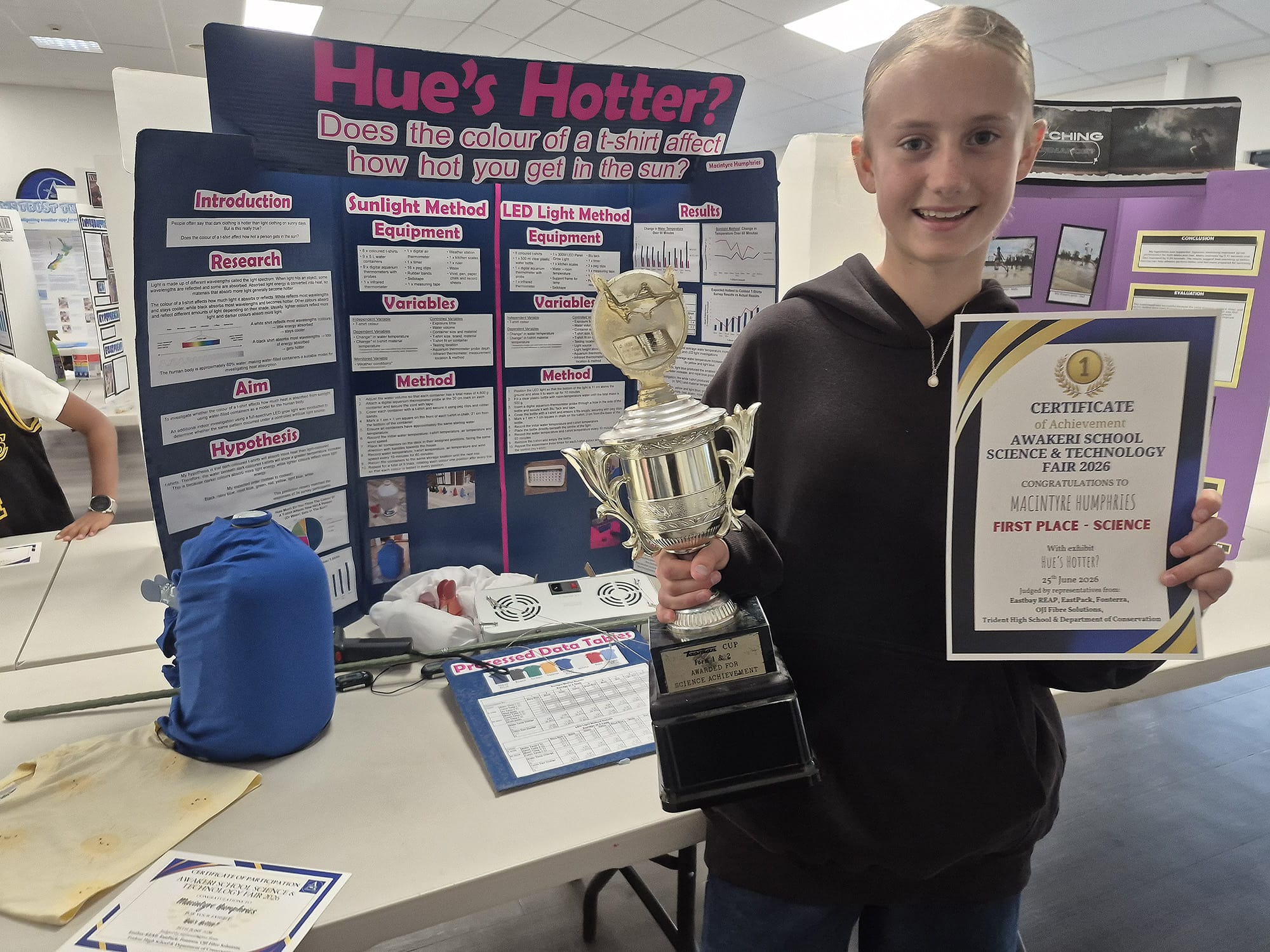
SCIENCE WINNER: Year 8 student Macintyre Humphries won the science division at Awakeri School’s Science and Technology Fair for her investigation into whether the colour of a T-shirt affects how much heat it absorbs from sunlight. Photos Tamara Herdman E6045-01
Tamara Herdman
Awakeri School students have once again put their scientific thinking and problem-solving skills to the test, with the school’s annual Science and Technology Fair remaining the only event of its kind still held in the Eastern Bay.
Forty-seven Year 7 and 8 students took part in this year’s fair, including 42 science investigations and five technology projects, with exhibits judged by professionals from the Department of Conservation, Fonterra, Oji Fibre Solutions, EastPack, Eastbay REAP, Trident High School and STEMM Horizons.
Acting Principal Louise Howard said Awakeri School had held the Science and Technology Fair since 1997 and remained committed to the event because of the extensive learning opportunities it provided.
“Students gain a thorough understanding of the processes involved in scientific investigation or the technology design process, including variable, hypothesis/need through to conclusion/final design, graphing results, and reflecting on and recording findings.”
“It goes far beyond science and technology.
“They learn how to conduct themselves in interviews and talk proudly about their work, speak to professionals, build relationships between home and school, develop presentation and communication skills, and work to a brief and a set timeline.”
“The immense amount of learning that takes place is something we are extremely proud of and is the big drive behind retaining our Science and Technology Fair.”
Each exhibit was assessed by industry judges before every student was interviewed, giving them the opportunity to explain their project, demonstrate their understanding and discuss what they had discovered.
Place-getters will now progress to the Waikato Science Fair in Term 3 after the Eastern Bay Science and Technology Fair was discontinued.
Many of the judges have supported the fair for years and were impressed by the quality of this year’s entries.
“The calibre was higher than they have ever seen. They were amazed what 11- to 13-year-olds can come up with to investigate.”
Howard said judges were particularly impressed by the range of environmental and interest-based investigations, while describing this year’s technology projects as the best they had seen because of their real-world applications.
Year 8 student Macintyre Humphries took out first place in the science division for her investigation into whether the colour of a T-shirt affects how much heat is absorbed from sunlight.
Using water-filled containers to model the human body, Macintyre tested a range of coloured T-shirts in sunlight before repeating the experiment under a full-spectrum LED grow light to verify the results.
“I was trying to find out, does the colour of the T-shirt affect how hot you get in the sun?” she said.
Her original plan to use people as test subjects was abandoned because there were too many variables.
“Since we couldn’t do it on a person, we did water, because our bodies are 60 percent water.”
While she expected dark colours to absorb the most heat, the experiments consistently showed royal blue produced the highest temperature increase.
“I was expecting the darker colours to get hotter, but royal blue is still in the dark colours.”
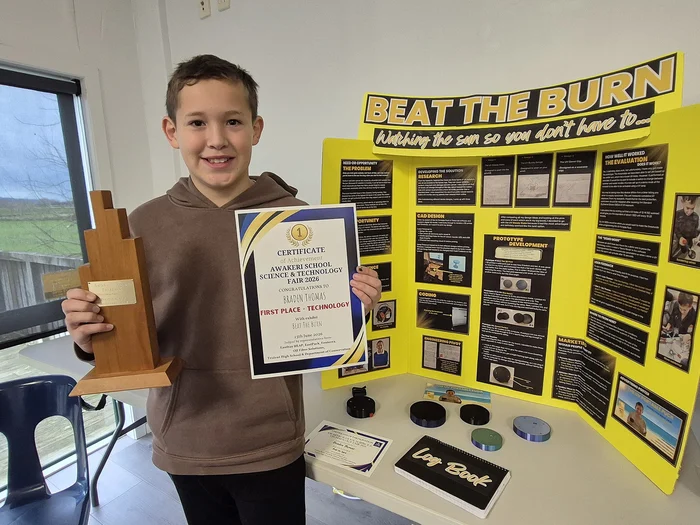
First place in the technology division went to year 8 student Braden Thomas, whose project, the UV Portable Puck, was designed to help people know exactly when to reapply sunscreen.
The handheld device measures cumulative UV exposure using a UV sensor and alerts the user once they have received enough ultraviolet radiation that sunscreen should be reapplied, rather than relying on a timer.
“I made a puck that measures UV exposure. It accumulates over time. And when you’ve had too much UV, it goes off and you reapply your sunscreen.”
Braden said developing the device involved several rounds of coding and refining the design.
“We had to change the coding a few times because it wasn’t perfect.”
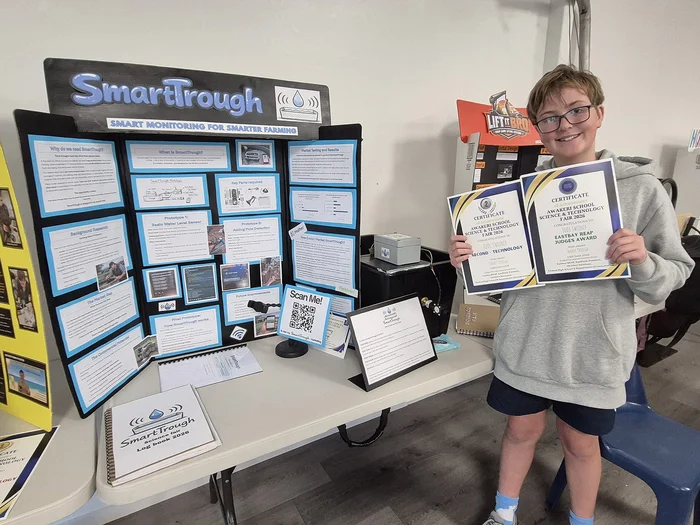
Year 8 student Jude Sweeney was awarded second place in the technology division, as well as the Eastbay REAP Judges Award, for developing SmartTrough, a prototype system designed to alert farmers if a stock water trough leaks, runs dry or overflows.
The device uses sensors to monitor water levels and water flow before sending notifications directly to a farmer’s phone, helping reduce water wastage while ensuring livestock continue to have access to clean drinking water.
“It watches the troughs, if it leaks or overflows.
“When the water level drops down, the notice goes to the phone saying, hey, your trough’s got no water. Or it will notify your phone saying, your trough has overflowed.”
Jude said creating the project had taken considerable time but had been rewarding.
“This took us a good amount of time, it was amazing to do, I really liked doing it.”
Winning the judges’ award was also a highlight.
“I’m quite happy I’ve won that because it’s an awesome award and no one else has it; it’s pretty cool.”
In the science division, year 7 students Corbin James and Camryn Bell shared second place.
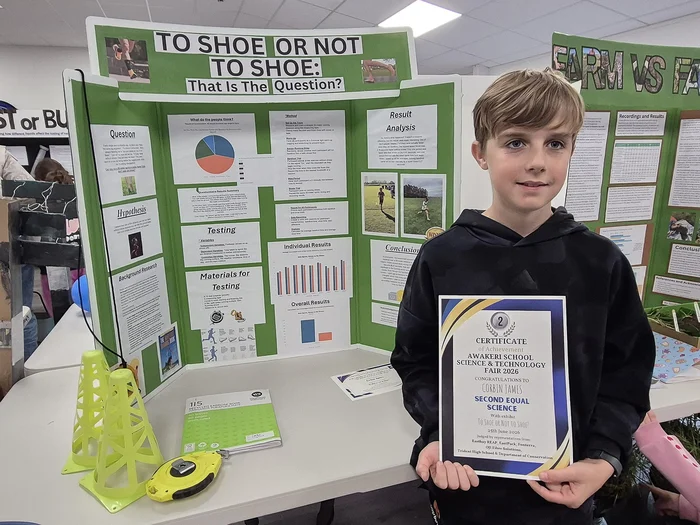
Corbin investigated a question that had sparked a long-running debate with his mum – whether running barefoot is faster than wearing shoes over a 50-metre sprint.
Testing nine members of his football team across multiple runs, Corbin found runners were, on average, 0.27 seconds faster without shoes.
“My science fair was about if you’re running in bare feet as faster than if you’re running in shoes over a 50-metre distance. Bare feet won by 0.27 seconds, so by not much.”
His conclusion also settled the family debate, with his project finding he had, in his words, “finally proved mum wrong”.
Camryn Bell shared second place in the science division for his project, Is Expensive Better?, which investigated whether paying more for everyday products actually resulted in better performance.