
Oji Fibre reports full compliance with Tarawera River discharge consent
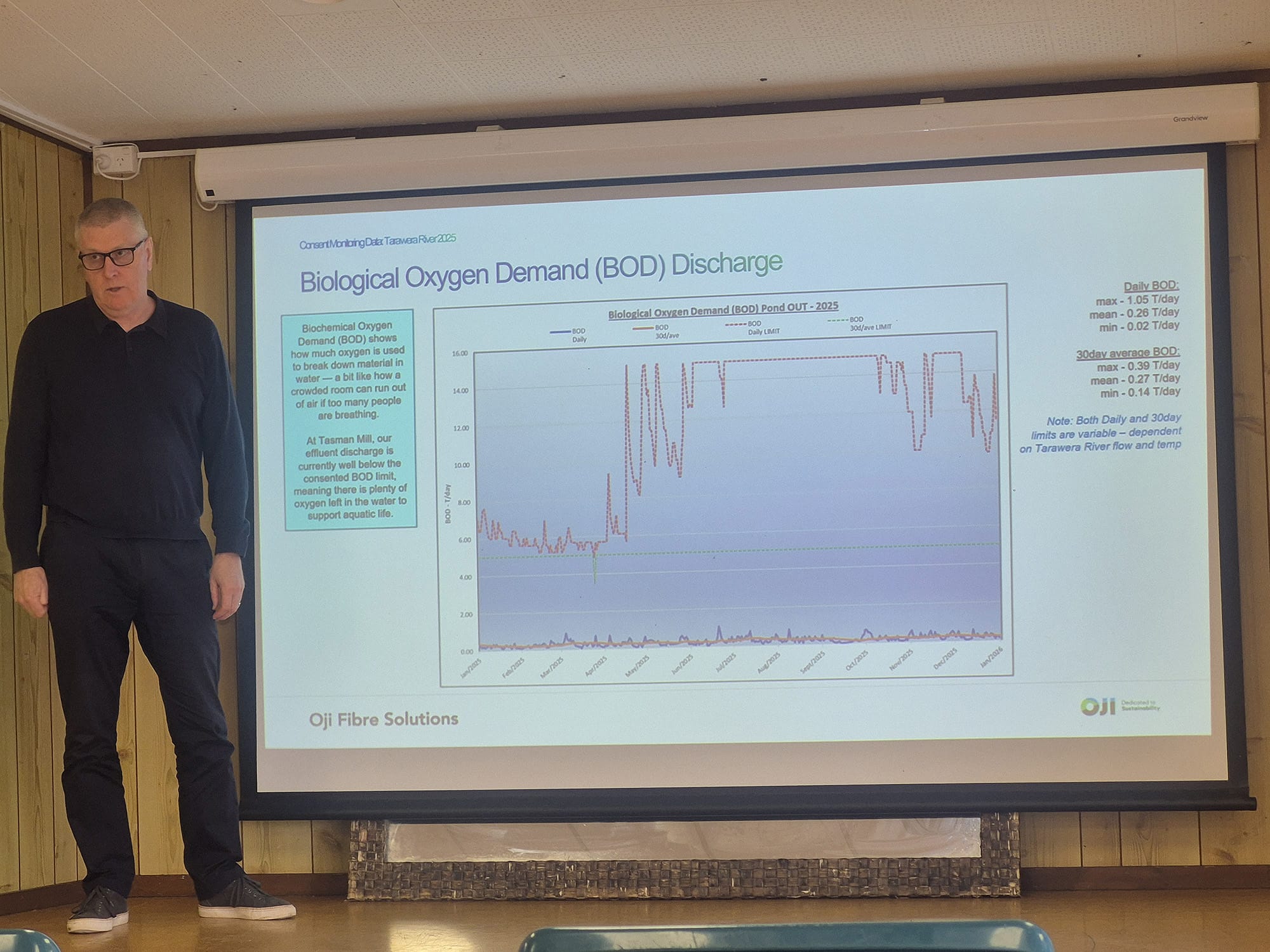
COMPLIANCE UPDATE: Philip Millichamp presents environmental monitoring results showing Oji Fibre Solutions remained fully compliant with its Tarawera River discharge consent requirements during 2025. Photo Tamara Herdman E6033-01
Tamara Herdman
Oji Fibre Solutions says it recorded no compliance issues during the 2025 reporting year and is already meeting colour discharge targets that are not due to take effect until 2035.
The company presented its annual environmental performance report to members of the public on Tuesday, outlining monitoring results for its wastewater discharge into the Tarawera River and answering questions about the mill’s environmental performance.
Group manager for environment and external relations Philip Millichamp said the company was fully compliant with its consent requirements during the reporting period.
Environmental manager Trudy Robertson said monitoring was carried out continuously and independently audited through consent requirements overseen by Bay of Plenty Regional Council.
“[The regional council] are regularly coming and seeing Trudy and walking over the mill and looking at the results – and the results are public,” Millichamp said.
A key focus of the presentation was the reduction in colour discharges into the Tarawera River.
Historically, colour has been one of the most visible concerns associated with the mill. Millichamp explained that colour came primarily from lignin, a natural component of wood that was separated during the pulp-making process.
He said a $63 million investment in 2019, which converted the Tasman Mill from a bleached to unbleached pulp operation, had significantly reduced the colour discharge.
“That meant we closed the bleaching systems, which was a big improvement environmentally. We’re not adding chlorine to the system, so there’s no chlorinated compounds going into the river.
“The bleaching process also washes out a lot more colour so there’s a lot less colour now going into the river.”
According to the figures presented, the mill is discharging less than 10 tonnes of colour per day, below the level it is required to achieve by 2035.
“We had to meet this level by 2035, but since we invested that $63 million and changed the mill, we’ve now been able to reasonably comfortably meet the 2035 target.”
He said the 10-tonne threshold was established during the consent process as the point at which any change in river colour should be “inconspicuous” to the eye.
“We’re below that conspicuous level now,” he said.
The presentation also covered water use, biological oxygen demand, suspended solids, pH, temperature and toxicity monitoring. All measures remained well within consent limits.
During the question session, a Matatā resident questioned the length of the 25-year consent granted in 2009 and asked what improvements had been made since the days when the river was commonly referred to as the “black drain”.
Millichamp acknowledged the mill’s environmental legacy but said substantial improvements had been made.
“We think it’s a lot better now,” he said. “There’s still work to do, but we’re getting good feedback.”
The company also highlighted environmental restoration work being undertaken through a memorandum of understanding with local iwi.
Millichamp said Oji Fibre Solutions was contributing funding to environmental projects around the river.
“We’re spending money on riparian planting work, and we have a little project near the mouth, near Matatā, that’s trying to establish an improved habitat for inanga,” he said.
Looking ahead to the expiry of the current consent in 2035, Millichamp said environmental expectations would likely continue to increase.
“We will almost certainly have to get better,” he said.
“We’ll have to take into account international comparison and benchmarking and New Zealand local situations, which is agricultural discharges and phosphorus and nitrogen and nutrients.”
He said Oji Fibre Solutions continued to investigate opportunities for further improvements, both within the mill and through advances in wastewater treatment technology, while balancing environmental benefits with economic realities.