
Opinion: MRI scanner for Whakatāne Hospital:What we know so far
.
■ Whakatāne District Grey Power Association president Dr Victor Luca explores the ostensible debacle over the project to develop a Magnetic Resonance Imaging suite at Whakatāne Hospital that was to have been operational by the end of 2024 and now is nowhere in sight.
Before treating disease, it is necessary to correctly diagnose disease. Up until the end of the 19th century, the toolbox for disease diagnosis was very limited, essentially relying on the categorisation of symptoms.
New scientific tools have taken diagnosis way beyond anything that could have been imagined in the 19th century.
The modern pathology laboratory allows the identification and quantification of the molecular, macromolecular and chemical components of blood and the identification of infectious agents such as bacteria and viruses (bugs, germs) in blood and bodily secretions and tissue, as well as a determination of the susceptibility of these bugs to chemical compounds such as antibiotics and antivirals.
Then there are the imaging tools that allow doctors to see inside the body in one- and three-dimensions and examine the morphology and functioning of organs and other anatomical structures in real time.
Medical physics has developed an array of tools for this purpose including planar X-rays, X-ray Computed Tomography (X-ray CT), Magnetic Resonance Imaging (MRI), Single Photon Emission Computed Tomography (SPECT), Positron Emission Tomography-CT (PET-CT) and Ultrasound at various levels of sophistication and resolution.
These techniques with strange sounding names are complementary. MRI image analysis using AI now allows rapid and accurate diagnosis of certain diseases that has already surpassed anything a human doctor can achieve.
Whakatāne Hospital, which services the huge area of the Eastern Bay, is equipped with brand new planar X-ray and a state-of-the-art X-ray CT scanner as well as cardio ultrasound imaging but none of the other mentioned techniques.
Whakatāne Hospital still lacks what is a marvel of physics, medical physics and biophysics, the MRI scanner. For many years now we at Grey Power have been hearing how our hospital is on the verge of getting an MRI scanner.
Our hospital’s scanner was to be owned and operated by a private outfit, Bay Radiology, which operates seven scanning facilities in Tauranga.
That is, seven for Tauranga and zero for the Eastern Bay.
According to data the Bay Plenty District Health Board provided me in 2021, each of these four scanners was processing fewer than four patients a day, suggesting the scanners are extremely under-utilised.
Normally, one would expect to process somewhere between 10 and 12 patients.
In some places around the country MRI scanners are publicly owned and operated; in others it’s an all private affair.
New Zealand wide about 40 percent of the MRI scanners are privately owned.
In the Bay of Plenty, the private RHCNZ Medical Imaging Group, New Zealand’s largest private radiology provider, has a monopoly.
The infrastructure investment firm Infratil holds a 51 percent stake in this company.
In 2021, I compiled a catalogue of all diagnostic imaging facilities in New Zealand. That required Official Information Act (OIA) requests to the 20 District Health Boards (DHB).
Each answered questions on what entity paid for the facility capital and operational costs and the patient throughput (number of patients per machine per day).
At the time, the four available scanners in the BOP were located in Tauranga. Health NZ (HNZ) does not have such a catalogue and is now refusing to provide information under the OIA that would allow me to update my catalogue.
I consider it scandalous that HNZ does not maintain such a catalogue as a matter of routine.
How can you manage diagnostic imaging services across the country if you don’t know where they, who owns and operates them and how many patients are processed?
It’s like owning a mechanical workshop and not knowing what tools you have at your disposal, only worse.
In June 2024, Grey Power invited Bay Radiology operations manager Sergio Fernandes to provide a status and update on the MRI scanner that was to be installed in our hospital.
We were told that a scanner was scheduled to be installed by December 2024, but that never happened.
The scanner had been purchased, the building had been consented, the building design completed and site preparation works were about to commence.
Since then, the instrument has sat in a crate in Auckland for about two years becoming obsolete while HNZ negotiated with Bay Radiology over the location of the scanner and scanning suite (the building) on our hospital’s campus.
I am not privy to the nature of these negotiations, the terms of the lease or the nature of the guarantee for the MRI scanner.
The question has to be asked why all this wasn’t sorted out before the MRI scanner was imported.
We have also recently been made aware that that MRI scanner has now been sent to Masterton, where a new facility will be built.
It is my understanding that the instrument will initially be installed in a temporary building and then moved to a newly constructed suite.
Hospital administrators initially ascribed the delays to the discovery of an earthquake fault-line running through the hospital campus.
The explanation for the delays subsequently became about negotiations over contract and lease arrangements.
Our new hospital manager and HNZ have been very coy about providing details on the nature of the delays.
As far as we can tell, the hospital would offer Bay Radiology a lease for the location on the hospital campus and they would pay to design and build the MRI suite.
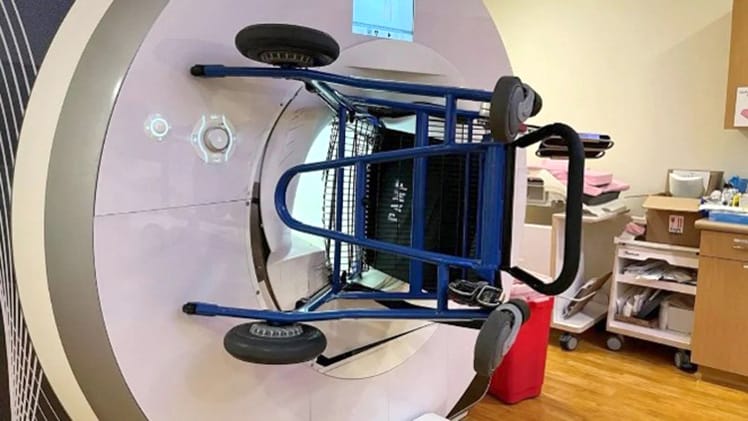
An MRI suite is a highly specialised facility, see image. The magnet is very heavy (4-0 tonnes) and generates powerful magnetic fields and radiofrequency fields.
The instrument is very sensitive to electromagnetic interferences and therefore requires good shielding.
An MRI suite also requires good temperature and humidity control.
The building requires facilities for handling helium since the scanner’s super-conducting magnet operates at near absolute zero (-273 oC).
I doubt the helium is going to be recovered and recycled.
Electricity and IT infrastructure will also be required.
There are strict design standards for health facilities and meticulous MRI suite design and construction planning is required. Highly trained technicians must be employed to acquire scans of patients.
To obtain an MRI scan, Whakatāne Hospital outpatients from the Eastern Bay must find their own way to Tauranga.
If you live in Whakatāne, that will involve a one-hour drive each way. If you are coming from the outer reaches of the region, you can easily double that.
For hospital inpatients, however, the situation is rather different. An inpatient is someone who has been admitted to hospital, which therefore has the physical and legal responsibility for that person.
As a Grey Power member who is a doctor pointed out at one of our recent meetings, inpatients in hospital care must be transported to Tauranga in an ambulance with a driver, co-driver and senior nurse, depending on their physical condition.
There is also an element of risk in transporting patients.
I recently sought under an OIA the number of inpatients transported to Tauranga for MRI and the associated cost for their transport.
The answer was that in 2025 about 23 Whakatāne inpatients were transported per month to the MRI facility at the Tauranga Hospital campus.
The average price of a scan was about $1100. So that’s $25,300 per month, or $303,600 per year. That is what Bay Radiology charges. The average duration of a scan is about 30 minutes.
The average ambulance transport of $473 per person adds another $130,548 per year.
So, that is a total cost of nearly $500,000 per year to process 23 inpatients per month.
Since Whakatāne Hospital is public, the cost of all MRI scanning of hospital inpatients is born by Government, or in other words, by the taxpayer.
Not to be overlooked in the case of outpatients are productivity losses for folk who have to leave work and make a return journey to Tauranga and back.
Also requested under OIA was a document referred to as a business case to support decisions on the purchase of the scanner.
A business case is a fundamental planning document that justifies the need for a specific project, initiative, or investment.
Whakatāne District Council prepares business cases all the time to justify projects.
You might expect that Health NZ would do the same.
A business case would contain comprehensive information and compare the costs of various options for inpatient and outpatient processing.
For instance, the business case might compare on-site and off-site scanning in a public versus private facility.
All associated costs would be quantified, along with hardware (scanner) and building design options, contractual requirements, responsibilities, risk analysis and so on.
All this would be done before venturing, or bumbling, into the set-up of an MRI suite.
A solid business case ensures rational and justifiable decisions are made and that there is accountability.
The response received for my OIA request for a business case was:
“No formal business case was prepared. There was a contractual arrangement with Bay Radiology relating to the placement of a fifth MRI scanner in Whakatāne. A proposal paper is currently being prepared for consideration by the relevant decision-making group.”
The absence of a business case prior to launching the project suggests a sort of improvisation or haphazardness about the now deceased project.
That a proposal paper is being prepared only after the demise of the original project seems rather belated.
HNZ utilises public money. It needs to be accountable to the public.
Plenty of questions could be asked about the nature of this new project proposal. Perhaps HNZ would care to provide it to me?
Since the original project was to have been some sort of public-private venture, the project, which at this juncture might justifiably be referred to as a debacle, has already cost considerable amounts of money.
There is also a significant opportunity cost and inconvenience to doctors who have to wait longer to make or firm-up a diagnoses.
The breakdown of contract negotiations might also raise questions of liability.
What can we make of this situation so far? What could the new project be?
I would suggest HNZ drops its insistence of public-private partnerships and goes it alone.
As I said at the outset, only 40 percent of scanning facilities in New Zealand are in private hands, the remainder being public.
We should remain public. I am sure that Trust Horizon would step up to the plate to help fund the MRI instrument if asked.
It has done so in the past for the original and replacement X-ray CT scanners at our hospital.
HNZ could organise the rest. They already have the building design and must know the costs.
I have already made this suggestion to HNZ, but met with no response.
We know the scanner that was destined for our hospital has now gone to Masterton.
Recent reporting has quoted a cost of $3.7 million for the new facility that they will have. I suspect this is for the instrument itself and doesn’t include the cost of the building.
Obviously, we are lacking lots of information on the structure of the arrangements that HNZ entered into with Bay Radiology.
I guess we could have requested the actual contract document under OIA. However, I strongly suspect that we would have been refused using the “commercial-in-confidence” excuse.
Wouldn’t it be great if HNZ would get its act together, come clean, and tell the people of the Eastern Bay what is going on.
The causes of the debacle described here suggest HNZ needs a serious health check because it is certainly not operating competently.
Issues such as lack of transparency, outsourcing to the private sector, and viability of public-private partnerships need to be put under the microscope.
Since writing this column, I have discovered the 2025 report of the Association of Professional & Executive Employees (APEX) on medical imaging.
APEX is the specialist union for all allied, scientific and technical employees.
The report “Broken Scanners, Exhausted Staff – Inside the Unravelling of HNZ Radiology Services” is a real eye-opener and makes the case for a project to rebuild public radiology services.
This is something that for at least six years we in Grey Power have been arguing for.
Readers will find in the APEX report that the Bay of Plenty ranks second only to Taranaki in terms of the crisis in medical imaging.