
Life Cycle Assessment of electricity generation options

.
■ In his Beacon letter of June 10, Paul Jamieson asked me to answer the question, “Is solar any better for environment in the long run?” When Jamieson says “better” we need to ask what he means by better. If he means that less greenhouse gas (GHG) emissions are generated over the lifetime of the current generation of solar photovoltaic (PV) panels, then the short answer is an emphatic yes, writes Victor Luca
Globally averaged across day, night, and all latitudes, Earth receives roughly 0.342kW/m2 of solar irradiance. This will continue for billions of years unless Earth is subjected to a sun-obscuring event such as may be the case from a super-volcanic eruption or nuclear war. At the equator at noon on a clear day the irradiance is roughly 1.0kW/m2.
In terms of the amount of power reaching the surface in New Zealand, this averages about 2.8-4.5kWh/m2 per day.
That is, quite a lot of power that the nuclear reactor we call the sun is bathing the Earth in on average every day. A solar panel can convert that energy into electricity with only a certain efficiency, typically around 20-25 percent with current technology.
Just to put that in context, my power bills show that over the months of January to July I used on average about 15kWh of electricity per day. In New Zealand on average I would be receiving about 3kWh/d from the sun per m2.
At 100 percent efficiency I would need only 3 square metres of panels to cover my entire daily needs.
But since current solar panel efficiency is conservatively about 20 percent I would need five times the area to cover my entire daily needs, ie, 15 m2. That is only about 15 percent of the floor area of my home.
To determine if solar is better for the environment in terms of reduced GHG emissions, it is necessary to conduct what is called a Life Cycle Assessment (LCA), which is a methodology to evaluate the environmental, social and health aspects of a technology in order to make better decisions.
The ISO 14040 is the international standard that establishes the overarching principles and framework for conducting a LCA while ISO 14044 specifies the detailed requirements and guidelines for conducting a LCA.
The LCA starts at the cradle (material extraction) and ends at the grave (end of life) and every step in between. The intermediate steps include panel manufacture, transportation, installation, operation and maintenance but there are many nuances in the methodology.
The LCA calculates the amount of CO2 equivalent emitted at each step for a given unit of electricity generated. The methodology requires establishing boundary conditions.
For instance, to extract the relatively pure SiO2 requires making silicon. That in turn requires the use of mining machinery such as diggers and trucks that use diesel and some kind of refining capability.
The machinery is made of steel, rubber and other materials that also have embodied carbon that needs to be accounted for.
To get an estimate of embodied carbon would require an LCA for each piece of mining equipment.
Choosing boundary conditions means defining exactly which processes, stages, and environmental impacts are included in the analysis, and which are excluded. Things can get very complicated very quickly if reasonable boundary conditions are not chosen.
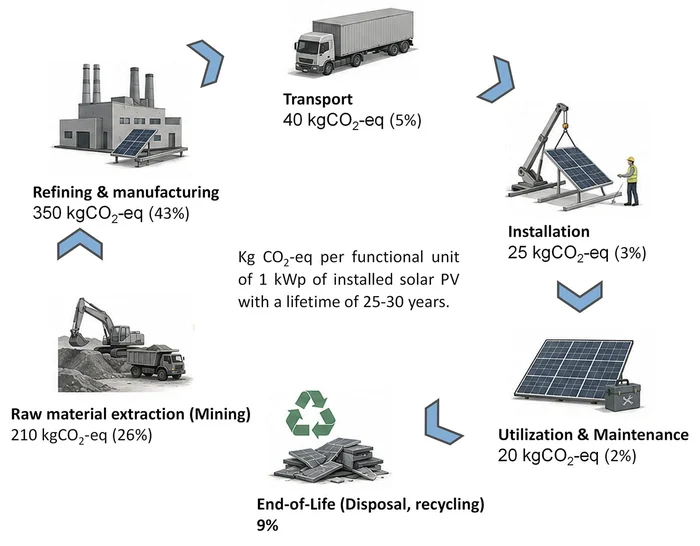
A LCA can be applied to each of the electricity generation technologies and comparisons made. I like to use data from a 2008 Singaporean study published by Sovacool et al in the academic journal Energy Policy.
The study is now dated but the numbers haven’t substantially changed.
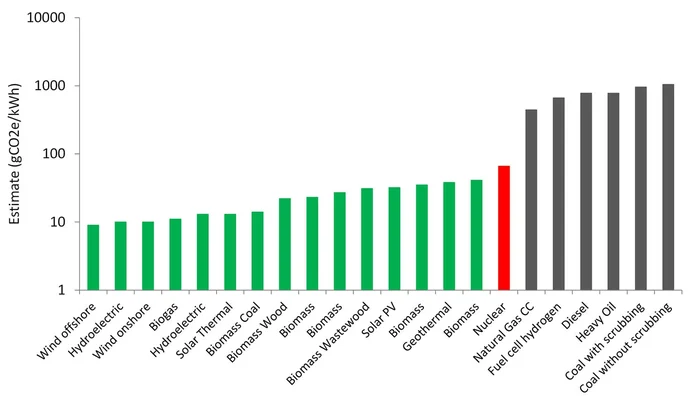
The study was a meta-analysis, which is a statistical technique that combines data from multiple independent studies to answer a single research question.
The below figure shows how much CO2 each form of electricity generation, emitted per kWh of electricity.
Note that the vertical axis is on a log scale. For solar PV the amount of CO2 emitted over the lifetime is 32 ± 10 gCO2e/kWh.
That is at least twice as good as nuclear and about 30 times better than coal and about 15 times better than natural gas.
A conventional state-of-the-art silicon PV panel degrades progressively over time at a rate of about 0.7 percent per year, depending on environmental and other conditions.
At that degradation rate a standard panel will reach about 80 percent of its original output after about 30 years. That is a significant improvement over legacy panels and is at least twice the lifespan quoted by Jamieson.
Scientists are studying the degradation or corrosion of solar PV panels over their lifetime with a view to extending the life expectancy. At the same time, panel efficiency continues to improve.
There is also considerable work being undertaken in the area of recycling. Recycling of silicon PV panels is possible but recycling comes with an energy cost. Panels are designed to be durable, which means that they aren’t easy to pull apart and recover potentially valuable materials like silver and glass.
Given how low the prices of new panels have become, current methods make recycling economically unviable for now, so that in the US about 90 percent of used panels end up in landfills.
Although solar energy is now the cheapest form of generation, it does have the drawback of intermittency. Electricity generation is optimised during the middle of the day when usage is lowest.
These days Li-ion batteries have got pretty good and so coupling solar PV to batteries helps to alleviate the intermittency problem.
If Jamieson wishes to discuss this matter further, then he should feel free to make contact.