Yacht club runs aground in dredging decision
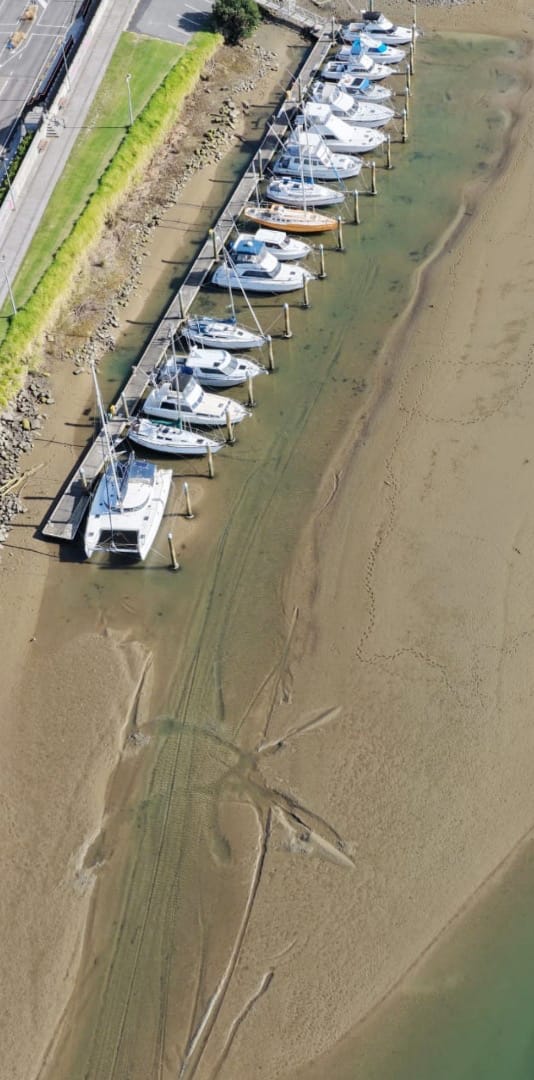
HIGH AND DRY: Boats grounded on a silt bar at Whakatāne Yacht Club’s marina at low tide over the past month. Photo supplied
Diane McCarthy
Whakatāne Harbour could lose half its recreational boating berthage after council’s refusal to dredge a navigable channel for a private marina this year.
Whakatāne District Council has declined an offer of $50,000 from Whakatāne Yacht Club to help toward the more than $350,000 price tag of reopening the channel to the club’s marina on the Whakatāne River.
On the advice of staff, the council voted six to four on Friday, with one member absent, to forgo the offer and not carry out the dredging in the coming year.
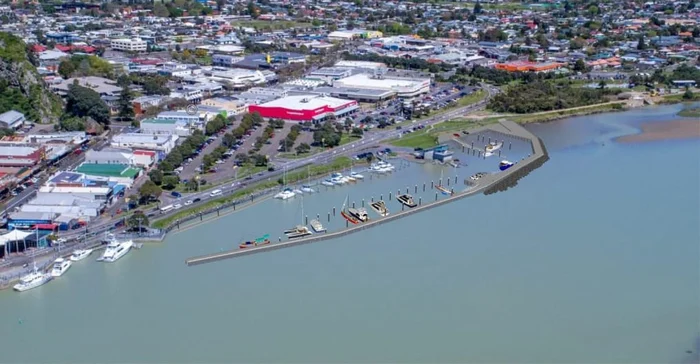
Since 1996, when the club built its 18-berth marina, the council’s ports and harbour’s operating budget has covered the cost of dredging the channel.
Since 2022, it has not dredged upstream of its own wharf at Otuawhaki (the Green Wharf), leaving silt to build up in the channel between Otuawhaki and the marina.
The budget, most of which comes from Harbour Fund assets, had been in deficit over the past three years and not sufficient to cover the cost of dredging, council staff said.
“One of the arguments I’ve been hearing is we have to do this because we have been doing it for 29 years. That just doesn’t wash with me,” Mayor Nandor Tanczos said.
“We have no formal memorandum of understanding and it seems to me that dredging in the past has been done on a ‘you scratch my back, I’ll scratch yours’ basis. That’s no basis for a council to be spending public money.”
He said people who were unable to heat their homes and struggling to pay bills shouldn’t have their rates increased further to support a private club.
He couldn’t think of any other example where the council funded, without contribution, other clubs.
He did, however, support the club’s aspirations to expand the marina.
“I do agree we need more berths, but I would expect those berths to make some contribution to the maintenance of what is, essentially, their own driveway.”
The club has informed the council that failure to carry out the dredging would likely result in the loss of the marina.
Its manager, Barry Cutfield, submitted the offer to help subsidise the dredging on behalf of the club, formed in the mid-1950s.
“The club is part of the fabric of the harbour,” he told Local Democracy Reporting.
“When [the marina] was built, it was a completely co-operative, supportive environment, a complete 180 degrees difference from what we’re experiencing now.
“This just about kills it,” he said.
He was heartened by several of the councillors saying they wished to workshop the matter further to better understand how they could support the club without increasing rates.
“There was good interest from some of the councillors.”
He refuted the ports and harbour operating budget not being sufficient to cover the dredging, saying the recent $172,000 deficit was caused by one-off expenses from the failed Te Rāhui Commercial Boat Harbour project.
Council chief financial officer Paul Davidson confirmed $118,000 in consultancy costs and $216,000 in interest costs related to the project, saying these were partially offset by a $105,000 government funding wash-up.
However, the operating budget still did not stretch to funding the entire marina channel dredging.
Further detail on the longer-term use of the Harbour Fund would be presented as a part of the upcoming Long-term Plan discussions.
Tanczos had been told by staff the club would not support alternative, cheaper dredging methods the council was trialing and would withdraw their contribution if that method was used.
Cutfield said this was incorrect. The club was not opposed any form of dredging that had the desired effect. There was no mention in the club’s offer that alternative dredging methods could not be used.
“We just want a result and it’s not our business how they go about achieving it. There’s a lot of technical things [council members] don’t seem to understand and I don’t think their staff understand. We’d be delighted to work through those with them.”
Councillor Wilson James had spoken in support of the club.
“Does Whakatāne want to remain a marine town or are we just going to let the harbour silt up?” he asked.
He felt the club’s aspirations to expand the marina to create 30 additional berths with an enclosing breakwater protecting it from siltation could possibly minimise the need for dredging.
He agreed with Cutfield that the Harbour Fund should cover the cost.
Councillors Lesley Immink, Carolyn Hamill and Malcolm Whitaker also voted to carry out dredging.
“The marina was established with a lot of support from regional and district council because they wanted to position us as a marine destination,” Immink said.
“If we don’t get on and dredge it this puts us at great reputational risk for not only the marine sector but for other projects and developers that want to come into the district.”