
Opinion: How local government works and what is about to change

.
■ A guide for communities ahead of the biggest local government reforms since 1989
■ Most New Zealanders interact with local government without thinking too much about which council is responsible for what. Your rates bill arrives, the rubbish gets collected, and the river beside your property gets managed. But by whom, and under what authority, asks Dr Mawera Karetai
The answer matters more right now than it has in decades.
■ Two councils, two distinct roles
New Zealand has two main tiers of local government, and most of the country is served by both.
■ Regional councils: There are 11, including Toi Moana Bay of Plenty Regional Council, managing the natural environment. They set the rules for how water is taken, used, and discharged; manage rivers and drainage to reduce flood risk; protect the region from pests and diseases; plan and fund regional public transport; and monitor air and water quality. They also carry significant Treaty of Waitangi obligations, including through Māori ward representation and engagement with iwi and hapū.
■ District and city councils: There are 67 across the country, taking care of what most people associate with “the council” in daily life: local roads, libraries, parks, building consents, zoning, drinking water, wastewater, and local economic development.
Both tiers operate under the Local Government Act 2002, are elected by their communities, funded through rates, and required to consult publicly on their long-term plans. In a small number of places, including Gisborne and Auckland, a single unitary authority holds both sets of functions combined.
■ Designed tension, not duplication
A common criticism of the system is that two councils mean “duplication and waste”. The picture is more nuanced than that.
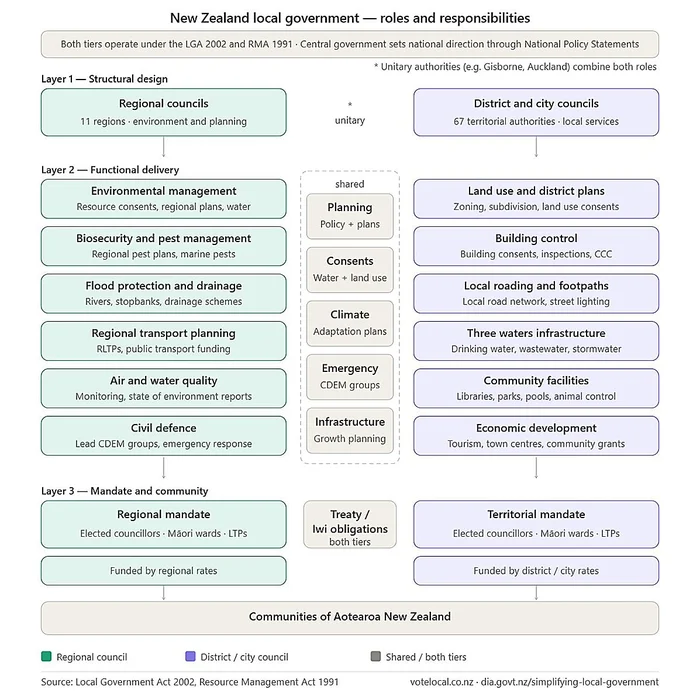
As you can see from the infographic above, most functions are clearly separated.
Keeping environmental oversight in a dedicated regional body means flood risk, water quality, and biosecurity are not constantly competing for attention against the demands of running libraries and fixing roads.
Some functions do span both tiers, for example, planning, consenting, climate adaptation, and emergency management all require coordination. Some friction in those shared spaces is arguably by design.
A system where environmental oversight sits within the same organisation responsible for approving housing growth and economic development carries its own risks. The reform debate needs to ask not just whether two tiers cost more than one, but what might be lost by collapsing them.
■ What the Government is proposing
In November 2025, Local Government Minister Simon Watts and RMA Reform Minister Chris Bishop announced proposals described as the most significant changes to local government since 1989.
The initial proposal would have replaced elected regional councillors with Combined Territories Boards made up of district and city mayors.
After public consultation closed in February 2026, with many submitters raising concerns about democratic representation, environmental oversight, and the absence of mandatory Māori representation, the Government refined its approach.
On May 5, 2026, ministers announced the “Head Start” pathway: a three-month window for groups of two or more territorial authorities to submit proposals to reorganise into new unitary authorities.
The deadline is August 9, 2026. Cabinet decisions are expected before the end of the year, with legislation to follow in 2027 ahead of the 2028 local elections.
Councils that do not engage will face a government-designed backstop process after 2028.
One thing is already confirmed: there will be no separate election of regional councillors in 2028. Those elected in October 2025 will serve their full terms.
■ What this means for communities across Aotearoa
Every region of Aotearoa faces these reforms with a different set of circumstances. Some are densely populated and economically complex; others are geographically vast, with small and dispersed communities.
Some have deeply established relationships between councils and iwi, built over decades.
The Government’s assessment criteria acknowledge this, requiring proposals to maintain a strong local voice and fair representation across urban and rural areas. But the three-month window for councils to respond leaves little time for communities to meaningfully shape what gets proposed on their behalf.
Across the sector, responses to the Head Start announcement have varied.
Some mayors have welcomed the opportunity for councils to lead their own reorganisation.
Others have expressed concern about the pace, with Whakatāne Mayor Nándor Tánczos describing the timeline as unrealistically tight and saying there was barely time for genuine community conversation.
Local Government New Zealand has called for flexibility, noting that different regions will need different approaches and that every council in a region, including the regional council, should be part of any Head Start discussion.
A concern raised consistently in submissions across the country is the absence of mandatory Māori representation in any new governance model.
Under the current system, Māori wards and Māori advisory committees provide structured pathways for Māori voices in both regional and territorial decision-making.
How those mechanisms are carried into new unitary structures is unresolved. For communities with significant iwi and hapū presence, and for regions where co-governance arrangements under Treaty settlements are already operating, this is not a minor design detail.
Regional functions like flood protection, biosecurity, and public transport will remain with local government under any new structure. How they are funded, governed, and kept integrated within merged organisations remains an open question, and one that communities across Aotearoa have a stake in getting right.
The window for councils to shape what comes next closes on August 9, 2026.
■ Further information is available at dia.govt.nz/simplifying-local-government. For a plain-language guide to how local government works, see pages 5–13 of the Vote Local Guide at votelocal.co.nz. The Bay of Plenty Regional Council can be contacted at boprc.govt.nz.