
El Niño expected to bring drier conditions to the Eastern Bay
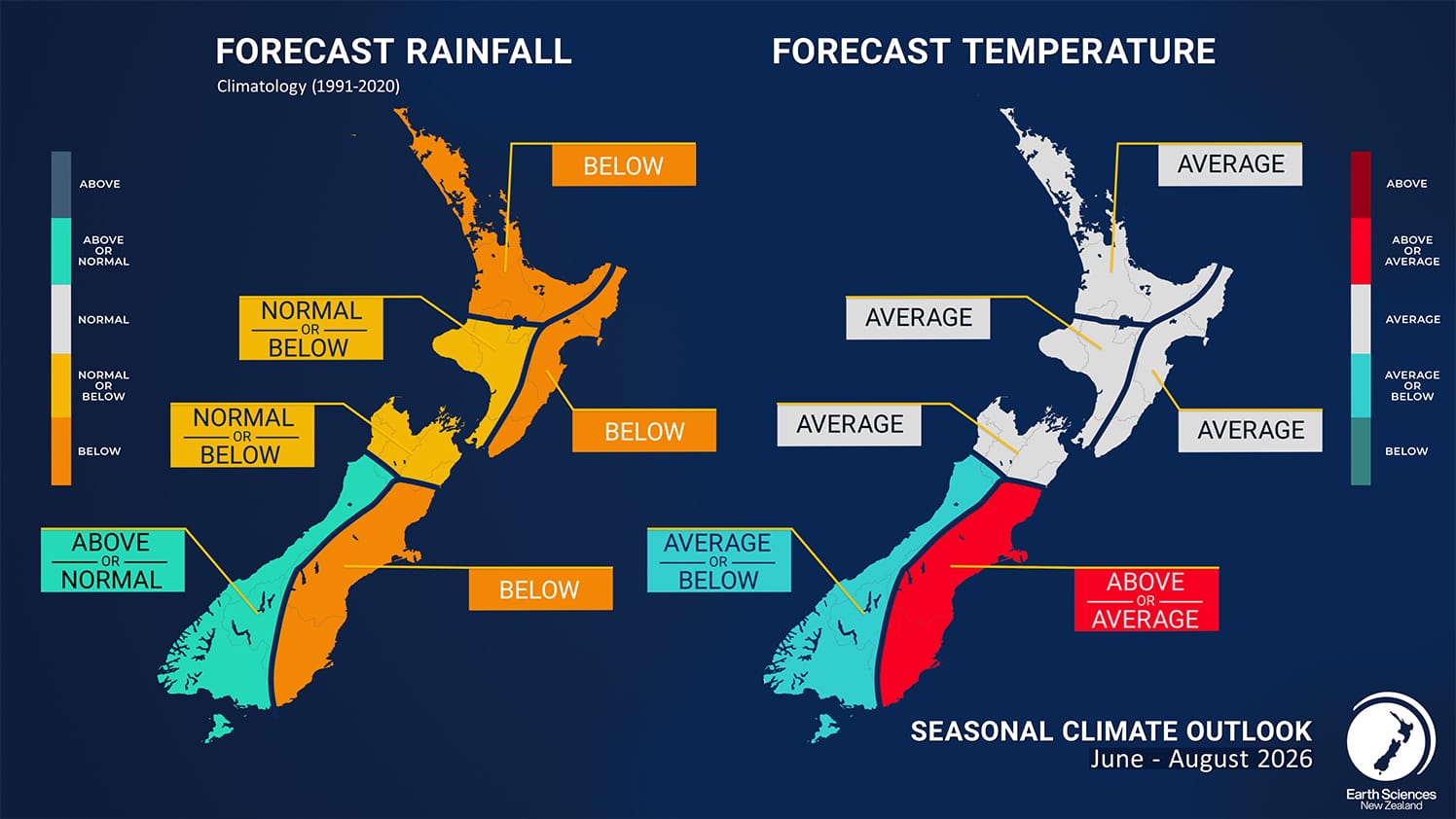
Forecasting: Forecast maps for rainfall and temperature from June to August.
Aston Palmer
the weather pattern that contributed to some of the heavy rain, flooding, and slips experienced across the Eastern Bay has come to an end, with meteorologists now forecasting a shift to drier conditions.
New Zealand has recently moved out of the La Niña climate pattern and is in what forecasters call an ENSO-neutral phase, the period between La Niña and El Niño. However, meteorologists are predicting El Niño will develop in the coming months.
“We are forecasting a big El Niño to form in the next few months,” said Chester Lampkin, meteorologist for Earth Sciences New Zealand.
According to Lampkin, there is a greater than 90 percent chance El Niño will form within the next three months, making it “all but certain” by the end of winter.
For the Eastern Bay of Plenty, El Niño is expected to bring drier-than-normal conditions through winter.
The weather pattern typically produces more southerly and south-westerly winds, which tend to carry less moisture across much of the North Island.
“We are forecasting drier than normal precipitation for much of the North Island, including the Bay of Plenty, for the upcoming winter,” Lampkin said.
The change could provide some relief for communities still recovering from recent severe weather events.
Lower groundwater levels may reduce the risk of flooding and slips by allowing the ground to absorb more rainfall when wet weather does occur.
Lampkin said drier conditions mIGHT also help people continue recovery and clean-up work following months of wet weather.
However, the forecast is not entirely positive. Winter is typically one of New Zealand’s wettest seasons, and reduced rainfall could create challenges for industries that depend on water.
“We do need some rain to recharge the groundwater and fill up reservoirs, rivers, and streams,” Lampkin said.
He said farmers and other industries sensitive to water supplies would be monitoring conditions closely.
“That will be the thing that drives concerns for the agricultural sector and other industries that are sensitive to water, like our water supply and some parts of the energy sector.”
While rainfall is expected to be below normal, temperatures are forecast to remain close to average throughout winter in the Bay of Plenty.
“In this particular case, we’re forecasting an average winter for temperatures in the Bay of Plenty,” Lampkin said.
The effects of El Niño could continue into summer, which also tends to be drier than normal in the region.
“El Niño summers also tend to be dry for us in the Bay of Plenty,” he said.
Despite the forecast, Lampkin stressed that residents should not expect rain to disappear entirely.
“It’s not likely that we’re going to suddenly become a desert. We are a small country surrounded by a vast ocean, so there will always be rainy days and drizzly days.”
Lampkin said El Niño should not be viewed as either good or bad, but rather as a natural climate pattern that brings both benefits and challenges.
“It won’t be too different from what we’re used to.
“There will always be patterns that produce unusually cold weather, and there will always be patterns that produce unusually warm weather.”