
Opinion: The case for an EBOP Council
.
■ Like it or not, the status quo is dead. The pressure for local government reform is mounting nationally, driven by a perfect storm: skyrocketing infrastructure costs, water management demands, climate resilience, soaring insurance premiums, and crushing compliance requirements. Quite simply, smaller councils can no longer fund massive infrastructure projects on the backs of tiny ratepayer bases, writes David Hick
For Whakatāne, Ōpōtiki, and Kawerau, inertia is the riskiest option of all. If reform is eventually imposed from above, the Eastern Bay risks being absorbed into a region-wide mega-structure dominated entirely by Tauranga and Western Bay priorities.
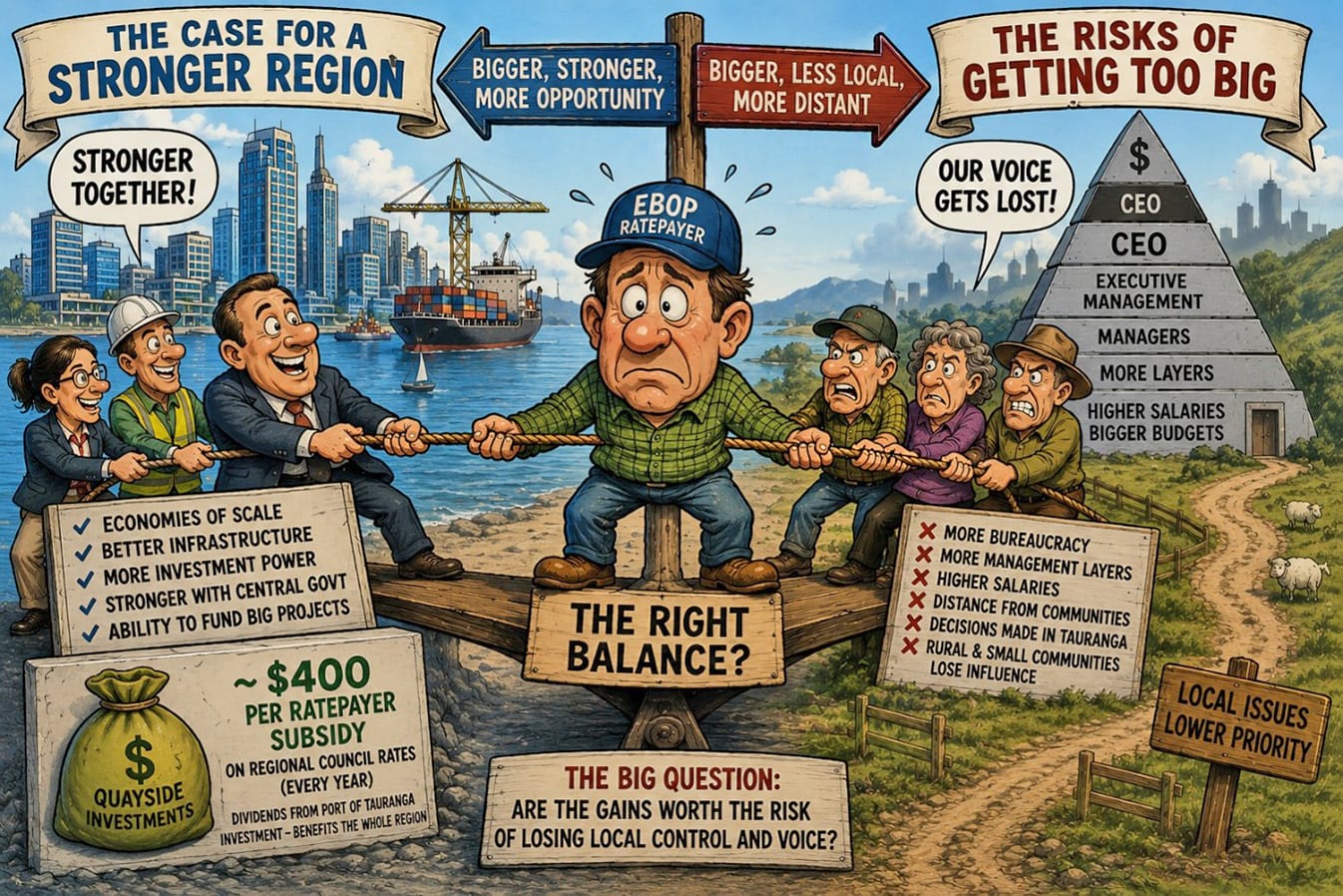
That shift carries undeniable risks:
■ Distanced decision-making: Power drifting away from local communities.
■ Diluted voices: Rural and provincial concerns drowned out by urban majorities.
■ Skewed priorities: Infrastructure spend increasingly focused on major metropolitan hubs.
■ Bloated bureaucracy: Larger management structures and more red tape.
■ Erosion of identity: The loss of unique local influence.
This is not a future any Eastern Bay resident should welcome, which is exactly why a unified Eastern Bay of Plenty Council deserves urgent discussion.
Amalgamating Whakatāne, Ōpōtiki, and Kawerau; offers a pragmatic middle ground between isolation and total Western Bay absorption.
A unified Eastern Bay structure would unlock the critical advantages of scale:
■ Eliminated duplication in administration and governance.
■ Shared specialist staff and regional planning resources.
■ Weightier bargaining power with central government Coordinated regional action on transport, water, and economic development.
Crucially, it preserves what matters most: local focus. An Eastern Bay-based council will always understand the nuances of provincial and rural communities better than a metropolitan bureaucracy ever could.
Furthermore, restructuring must not mean forfeiting existing regional assets. If the Bay of Plenty Regional Council is reconfigured, Eastern Bay communities must retain their proportional share of returns from Quayside Holdings, the council’s investment arm that holds a major stake in the Port of Tauranga.
Currently, Quayside returns subsidise regional council rates by roughly $400 per household annually. This income stream is a vital community asset; it must be ring-fenced in any governance transition.
An Eastern Bay Council won’t be a silver bullet. Costs will still rise, infrastructure will still require massive capital injection, and transition always carries risk.
But it offers the ultimate modern compromise: enough scale to remain viable, yet small enough to remain genuinely local.
This leaves the Eastern Bay facing a definitive choice.
Do we ride the coattails of a larger, wealthier Western neighbour, accept a diluted voice, and hope the economic crumbs fall our way? Or do we seize control of our identity, betting that a unified Eastern Bay structure can achieve the scale and resilience required to thrive?
The real debate is no longer whether change is coming; it is whether local communities will shape their own future before someone else decides it for them.
Because local government is not just about efficiency. it is also about representation, identity and who gets heard.
