
Opinion: Latest council deficit discussions on a dead end?
.
Whakatāne Action Group
Observing last Thursday’s Whakatāne District Council finance, performance and risk committee meeting it appeared to us that the discussions about how to decrease the operating deficit are on a dead end.
Yes, there were some questions from councillors, two in particular, about how to interpret the four bullet points given on page 191 of the agenda but fundamental questions about how to reduce it remained absent from the discussions.
The council chief financial officer explained that the deficit on “All Activities” is lower because capital projects aren’t delivered on time (For the 2025/2026 annual plan year to date only 38 percent has been delivered meaning council budget managers have only nine weeks left for the remaining 62 percent.)
He also mentioned that a relative high proportion of the debt is secured against the council’s Three Waters assets.
He mentioned a gearing of 3.5 for those assets which is unsustainable high. (We can understand that there is still some reluctance from our other council partners in working with the council.
Kawerau brings only $8m debt and Ōpōtiki $13m, according to consultants Martin Jenkins)
“The WDC needs to modify its level of debt to achieve a more realistic outcome from future price and costs modelling for running a multi council water delivery organisation”, according to the same consultant. This means debt needs to be relocated from 3 waters to other assets within the council.
■ What is now exactly the problem?
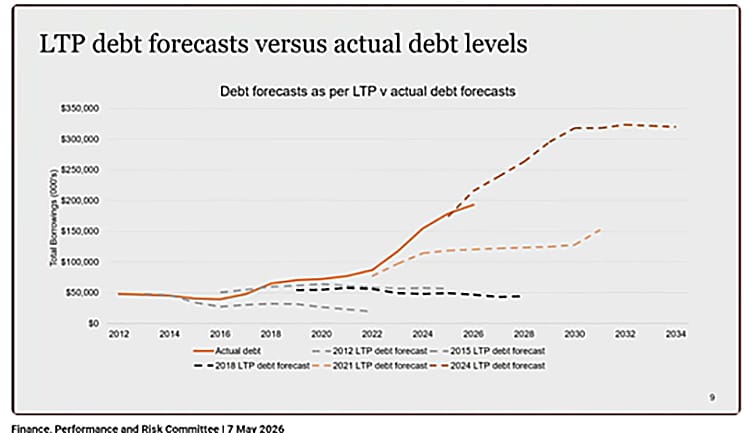
The problem is illustrated in the graph above, which was presented at the meeting by Brett Johanson and Raj Varma from PWC (Price Waterhouse & Coopers) which supply treasury services to the council.
Treasury services means providing liquidity, debt and interest management.
The graph at top shows what is the core of the problem: poor forecasting of debt attached to Long-Term Plans (LTP).
Yes, we know we have to apply some leniency towards Covid, but we would expect a more conservative and prudent attitude to debt from 2022 onwards. But we observe the opposite.
It exploded to almost $200 million. The gap between what is forecasted and what is real is only growing. It looks like that the latest LTP is getting some grip on it, but debt is still growing in an absolute way.
With the growing debt comes the growing interest payments.
As pointed out by the PWC employees: An increase in interest rates of 1 percent will cause a 2.44 percent rate increase to compensate.
■ Do we achieve anything with the increasing the debt?
With so much debt you would argue that Whakatāne is a great place to live with fabulous amenities and facilities where everybody wants to relocate to.

The real world is different as the ‘Non-Financial and Organisation Performance Quarterly Report’ shows. Pictured above is a graph presented at the same meeting that council is on track to achieve this year only 40 out of 69 performance measures which is 58 percent. Not much more than a C- grade, we would argue.
Almost one year later we are about to achieve the same result but, in the meantime, we have added another $20m or so of debt.
Clearly, there is a link absent which feeds the result back towards the planning stage.
A feedback loop as we call that in business. You need to measure the effectiveness of your actions against your initial intensions.
We mean that in a LTP you plan to improve a certain service, and you schedule actions and a budget against it, then the expectation is you change your actions when that earmarked result is in danger. It is not difficult! It is common sense.
It is the same with the (operating) deficit. It grows and grows, but there are no corrective actions planned so nothing will change.
The council takes comfort from anecdotal evidence provided by PWC that every council in New Zealand is in about the same position.
Our Mayor Nandor Tanczos recently had something to say about a Taxpayers Union report.
He described it as “melons versus blueberries”.
We would call it “rotten tomatoes versus rotten tomatoes” with the caveat that every tomato, representing a New Zealand Territorial Authority, decays in a different way.