
‘Not one acre more’ – urupā kaitiaki
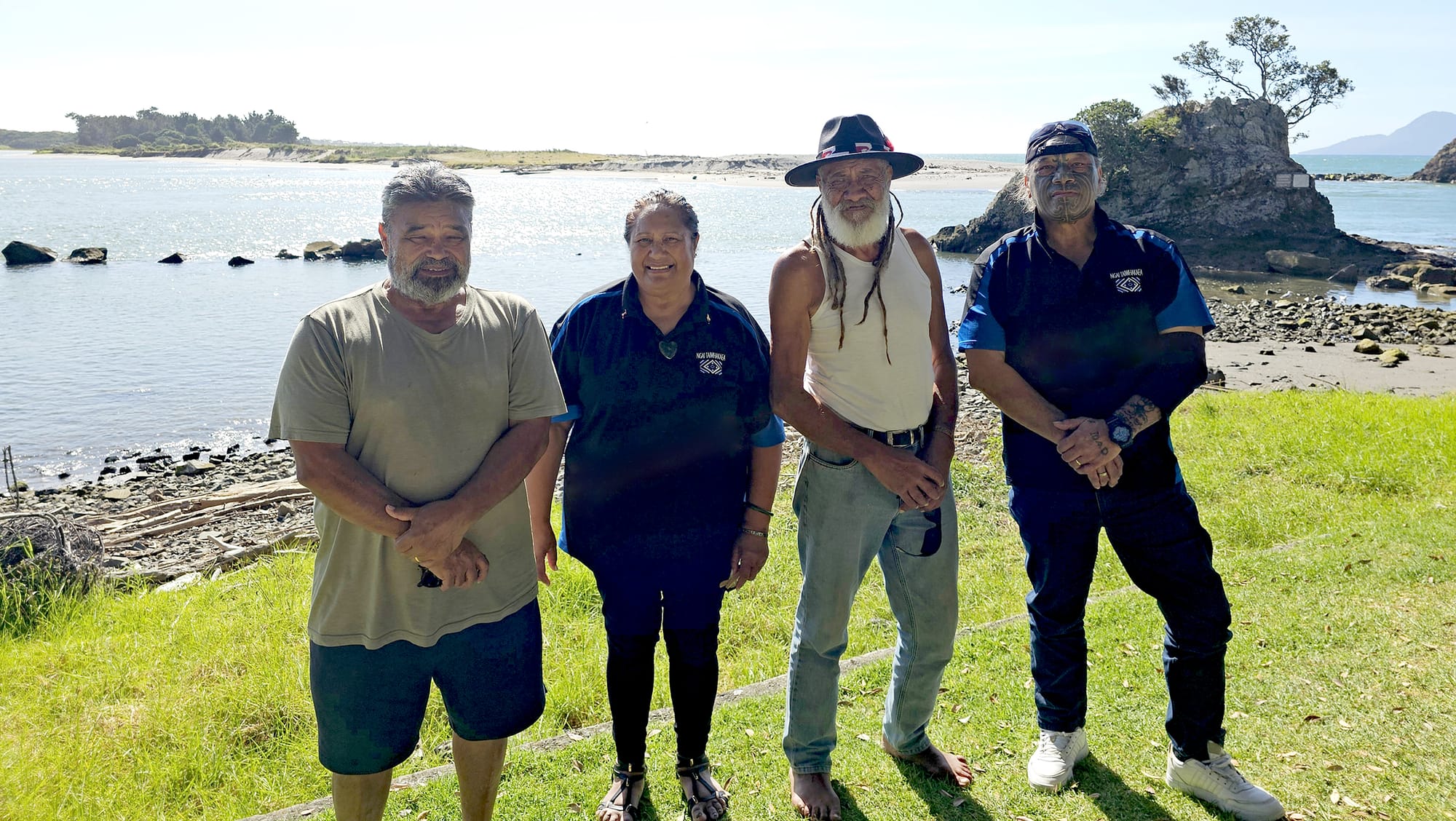
Kaitiaki: Hemi Hireme, Caroline Takotohiwi, Rapata Kopae and Manukorihi Tarau are determined to stop development at Ōpihi Whānaungakore, across the river from Whakatāne. Photo Diane McCarthy E5888-04
Diane McCarthy
“As long as our tīpuna are happy, we will carry on,” says Rapata Kopae, one of the Ōpihi Whanaungakore trustees battling to stop development of land they say is wāhi tapu.
Mr Kopae has been taking tūpāpaku (deceased people) to be buried at Ōpihi Whanaungakore since 2003 and says the area is “extremely tapu”.
He goes through extensive whakanoa (protection and removal of tapu) processes before and after visiting the site ever since he first volunteered for the duty.
Stripping naked, cleansing in the river multiple times and karakia are all part of the process.
Despite this, he said at least one of his fellow gravediggers had experienced visions of the spiritual realm after taking part in a burial.
“He doesn't like to talk about it. He didn’t eat for seven days, he didn’t sleep. He said, ‘Bro, I went to this place, and it was beautiful and I didn’t want to come back’ ... He says he could hear his son calling out to him and that brought him back.
“The fact we went through all those processes of taking away all the tapu that we had on us as we did that mahi ... That whenua is still as strong as when the tīpuna first used it.”
The late Ringatu minister Ching Tutua carried out those early protective karakia.
“I have to do the karakia now. It’s about how we protect people as well as that whenua.”
Mr Kopae has been opposing development of the site since 1999 and while the trustees await judgement from the Environment Court on whether development will be allowed, he is happy to help educate anyone about the importance of “Mātaatua’s spiritual homeland”.
The 26.9 hectares of Whakatāne District Council-owned land sits to the west of the 56 acres (22.5ha) formally surveyed by Europeans in the 1800s as being the historic urupā Ōpihi Whanaungakore. All these lands were confiscated by the government in the “raupat” of 1866.
In the late 1990s, Te Rūnanga o Ngāti Awa wanted resource consent to locate the Mātaatua wharenui on the land, thereby creating a buffer zone between the urupā and residential areas.
“Their vision was to take the wānanga [Te Whare Wānanga o Awanuiārangi] and build it beside the whare complex, as well as a cultural centre,” Mr Kopae said.
He was one of those who formed a group called Te Toka Tu Moana o Irakewa in 1999, described by elders within the rūnanga at the time as “a group of young radicals”.
“We formed this group so that we were outside the marae where our koroua couldn't actually tell us to sit down and be quiet,” Mr Kopae said.
They took the case as far as the High Court but said they never had a chance of winning.
“We had no lawyers. What we did have was the korero of the last gravedigger from 1936. His name was Claude Kingi.”
Mr Kingi carried out the last burial at Ōpihi Whanaungakore in 1936, until they resumed in 2003. He died in 1999.
“When he was asked about where is Ōpihi, he said from Turuturu Roimata, (a rock situated in the Whakatāne River mouth), to the next urupā, Utairoa.”
Utairoa Urupā is thought to be located east of Ohuirehe Road.
“The biggest thing about using our uncle’s korero was the koroua in the courtroom couldn’t bash the korero.”
Though the group lost the appeal, they took some heart from the judge’s words when the opposing lawyers sought costs from them.
“The judge’s words were, ‘I cannot award costs against these young people because they speak from the heart’. Although we had our little grin there, we still lost.”
Having spent two years gaining resource consent, increased land prices eventually caused the rūnanga to locate the wharenui where it is today, across the river from Ōpihi Whanaungakore.
Mr Kopae said what gave him the most strength in the fight to protect the land from development was the approval he received from the tīpuna buried there.
“In 2016, we were called to Ōpihi by the tohunga from Taiwhakaea and we met him at the new urupā we have at Opihi Whanaungakore.
He said the tīpuna wanted him to share a korero with all the people who had been working at the urupā.
“The korero we were given was that we were doing a good job and we should carry on.
“A korero like that. That’s the strongest thing that a person like me could hear. It helps me to concentrate on the tapu of the whenua.
“It’s a never-ending job because you can’t tell the tīpuna that I want to knock off now.
“We’ve got a new generation of kaitiaki who want to uphold the tikanga that was passed down. We’ve got to hang on to Ōpihi.”
Hemi Hireme was the only trustee able to give evidence in the Environment Court hearing on February 10, in which the trustees tried to have the Archeological Authority to develop the land reversed.
“We know that when LORE walks into LAW it’s always going to be an uphill battle,” Mr Hireme said.
Mr Hireme believes protecting Ōpihi Whanaungakore could benefit the wider Whakatāne community and be a model for the country.
“We are talking about the spiritual homeland of 50 percent of our community. That doesn’t include the broader Mātaatua whānau, which is a quarter of a million people. [It] is as much about our collective future as it is about the past.”
“It is a story about the tension between iwi corporate entities and hapū, which is not limited to Ngāti Awa,” he said.
“Since 2014, up until December last year, the rūnanga and hapū were unanimous in opposition to any development taking place.”
In December, 17 delegates from various Ngāti Awa hapū voted nine to eight to accept a proposal to allow development at a reduced scale, with a 500-metre buffer zone between residential homes and the official urupā site.
“To my understanding, it was questionable whether it was informed consent. There was much of the detail missing and no opportunity to go back to the hapū to consult,” Mr Hireme said.
He questions the integrity of that democratic process. “That decision took away the unity, the solidarity that Ngāti Awa had. To say that it is a reduction in the scale of development is not an argument for us.
“That’s our spiritual homeland. It’s not a commodity to be bargained with. We don’t make deals with the sacred.”
Te Rūnanga o Ngāti Awa chairman Tu O’Brien said the rūnanga made its decisions according to its charter and was accountable to its hapū through its elected representatives.
“From time to time, our decision-making processes involve a forthright exchange of views. In any event, those decisions are matters for the rūnanga, the hapū and our uri.
Mr Hireme describes the desecration of wāhi tapu as shameful to the mana whenua.
“Imagine the pressure our kaumatua have been under since the ’30s, watching their wāhi tapu being desecrated, being concreted over, being destroyed, and how harmful and painful and shameful that must have been to them.
“Rangatahi are waking up to that history and saying, ‘no more’. We are refusing to submit to that shame anymore. Not one acre more.”
Another interested party, Ngāti Awa hapū Ngāi Taiwhakaea, who are mana whenua of the area, plan to take the matter further.
Ngāi Taiwhakaea was previously party to the Environment Court appeal by Te Rūnanga o Ngāti Awa against the Heritage NZ decision to grant archeological authority to developers of the block.
When the rūnanga withdrew its appeal, it meant Ngāi Taiwhakaea was no longer able to give its evidence.
It was left to the trustees, who had entered their own appeal, to make their case in court.
Te Rūnanga o Ngāti Awa has been approached for a response to this matter.

■ The following statement has been sent to the Beacon by Ngāi Taiwhakaea.
Ngāi Taiwhakaea are tangata whenua with kaitiakitanga and mana whenua of the area that encompasses Ōpihi Whanaungakore.
The area subject to the proposed development is part of our urupā, Ōpihi Whanaungakore. This area is of profound cultural and ancestral significance. Our hapū is named after our tūpuna who are buried there. Ōpihi Whanaungakore forms a part of a wider coastal landscape of urupā.
Ngāi Taiwhakaea oppose the development of our urupā. Our commitment to protecting our wāhi tapu has not changed, just like our responsibilities to our tūpuna have not changed.
The trust is dealing with the Environment Court proceedings.
We made the difficult decision to withdraw from the Environment Court and instead focus on a judicial review of Heritage New Zealand’s decision to grant authority to modify or destroy our wāhi tapu.
The judicial review will focus on the lawfulness of Heritage New Zealand’s decision-making process. Among other things, it will raise issues around whether relevant matters were properly considered, including engagement with us, as mana whenua, and its Treaty obligations.
Ngāi Taiwhakaea remain committed to ensuring that wāhi tapu are treated with the seriousness and respect they deserve.
Ngāi Taiwhakaea will also engage in the Waitangi Tribunal process relating to these matters, including issues around the protection of wāhi tapu and the Crown’s Treaty obligations. It is deeply concerning when decisions affecting wāhi tapu proceed without meaningful engagement with mana whenua. Our burial sites are not commodities. They are taonga of the highest order.
As these matters will soon be before the High Court and Waitangi Tribunal, further comment is limited.
The generations before us were kaitiaki of this space. The mantle now rests with us.
We will not shy away from that responsibility.