
Kawerau bathers left in the cold by steam bore issues
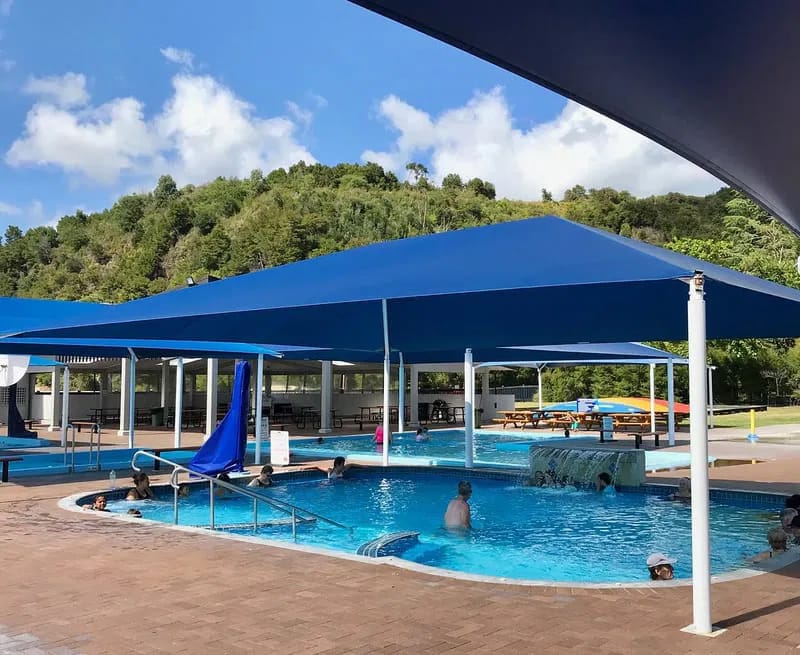
<span style="white-space: pre-wrap;">Magic spot: The huge spa pool at Maurie Kjar Aquatic Centre in Kawerau is popular when it is working well, even in mid-summer. Photo supplied</span>
Diane McCarthy
Pool users haven’t been able to enjoy their regular hot soak at Kawerau’s Maurie Kjar Aquatic Centre for a few months.
Kawerau District Council is asking the community to be patient as it works through ongoing problems with the geothermal steam bore that heats water for the pool complex.
Potential solutions have been raised with the council by concerned residents with regard to ongoing maintenance.
Chief executive Morgan Godfery said the council was committed to transparency and resolving the matter efficiently and appreciated the time residents had taken to raise issues and potential solutions.
“If people have specific details or further technical suggestions, please provide them, and we will review them promptly.”
However, the council asks people to be kind to the pool staff.
“The issues with the geothermal bore are structural issues with the bore itself – they have not been caused by lack of maintenance or operational issues,” a spokesperson said.
The council had actively sought and incorporated advice from qualified geothermal experts, including contractors with extensive experience in the Kawerau and neighbouring geothermal fields, local operations staff from geothermal power stations, and the geothermal regulators at the Bay of Plenty Regional Council.
“This has guided our approach to addressing the bore’s challenges, such as silica and calcite scaling, quenching due to rainfall, and the bore’s shallow depth.”
Staff are working with external partners and contractors to provide various solutions and potential funding avenues with the aim of keeping costs to a minimum for the community.
The Maurie Kjar Aquatic Centre is a council facility with free entry. It includes a 25-metre main pool, three smaller pools for play, learner swimmers and babies and a 40-person capacity spa pool, normally heated to between 38 and 40 degrees Celsius year-round.
The spa is extremely popular with older members of the community, several of whom can be found soaking even on the hottest days of the year, when it is working properly.
A retired Kawerau resident, who did not wish to be named, told The Beacon the issues had been ongoing for three-to-four years, with breakdowns lasting three-to-four months at a time.
“It’s absolutely magic when it is working. Sitting with a hot jet on your back is marvelous to relieve aches and pains,” he said.
“There’s a line-up of about a dozen people when they open in the morning.”
Over the winter of 2020-2021, the original bore, which had been heating the pool since the early 1970s, stopped producing steam resulting in the complex having to be closed. It was replaced with the current steam bore, drilled in November 2021.
Problems with the new 79-metre-deep bore started in 2023.
Calcite and silica build-up was found to be blocking the bore, and this prompted a clean-out of the bore in September 2023.
Another major workover was completed in January this year, which cleaned out calcite down to a depth of 60.5 metres.
Several issues have since been identified by the experts, besides the heavy calcite scaling inside the bore blocking the flow of hot water.
Pressure tests in 2025 showed there was weakness in the bore casing below the 60-metre depth.
It was possible cold water was leaking into the bore casing, cooling the hot water and stopping natural flow.
Experts also said the bore had insufficient depth. Mapping of the geothermal field showed the hot zone started deeper than the bore reached, limiting reliable output.
Long-term solutions to restore heat to the pools at the optimum temperatures were still being investigated and costed.
A potential solution to mitigate the build-up of the calcite and silica had been chemical treatments and high-pressure air treatments.
Last month, the council engaged contractors to install a chemical line, which can also be used to inject air via a compressor into the bore.
A programme of works included casing integrity tests, wellhead maintenance, pump tests, valve servicing, and regular monitoring of flow, temperature, and discharge quality to ensure compliance and minimal environmental impact.