
Support fills tribunal hearing for Murupara doctor

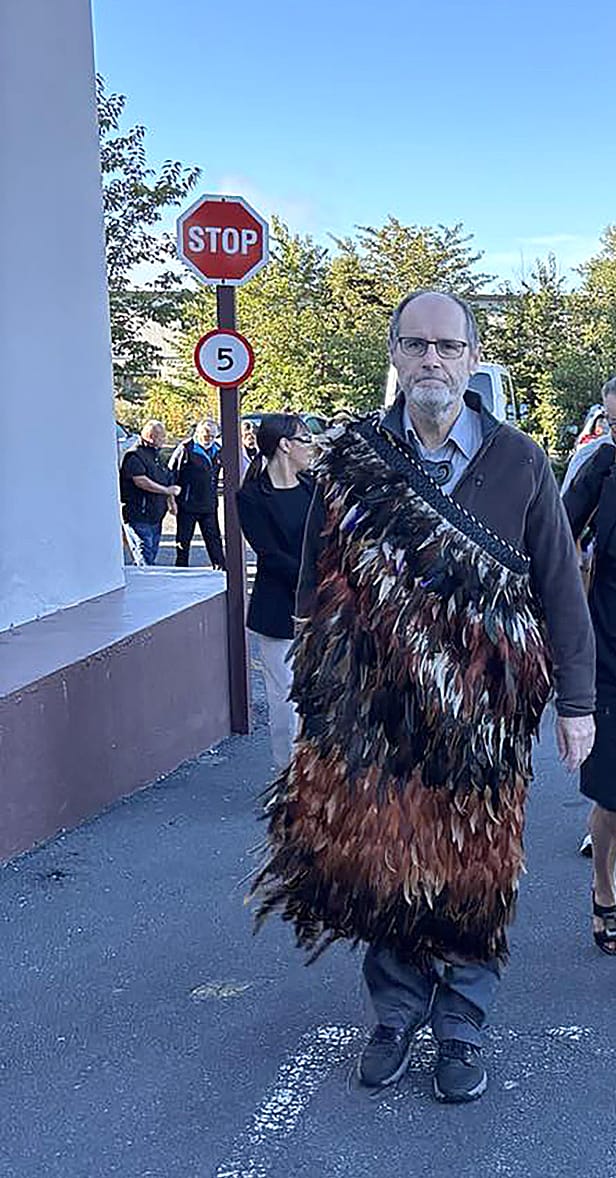
DAY ONE: Dr Bernard Conlon at the New Zealand Health practitioners Disciplinary Tribunal hearing. Photo Kathy Forsyth E5893-01
Kathy Forsyth
There was standing room only on Monday for the opening day of a New Zealand Health Practitioners Disciplinary Tribunal hearing into the conduct of Murupara doctor Bernard Conlon.
More than 100 supporters – many believed to be patients from his practice – packed into a conference room at the Arawa Park Hotel in Rotorua for the hearing between the Professional Conduct Committee (PCC) of the Medical Council of New Zealand and Dr Conlon.
The hearing, which is expected to run for about two weeks, is examining allegations relating to Dr Conlon’s actions during a nine-month period in 2021 and early 2022, during the Covid-19 pandemic.
One supporter said many more people wanted to attend the hearing, but attendance would need to be rotated because of limited space.
Proceedings were briefly interrupted on Monday morning when counsel for the PCC raised concerns that the hearing was being “livestreamed” online.
Earlier, the tribunal chair had instructed those present that dissemination or publication of the hearing’s contents was prohibited, and that witnesses giving evidence had name suppression.
The woman responsible, believed to be connected with an online media platform, admitted making a brief online post and naming a witness.
Supporters were temporarily asked to leave the room while the tribunal panel spoke with her behind closed doors.
The person later apologised to the large group gathered outside, saying she had arrived late and had not heard the instructions about the restrictions.
“I did a five-minute update to let the good people of New Zealand know about this amazing hero of a doctor,” she said.
The five-member tribunal is chaired by Truc Tran, who explained that the burden of proof rested with the PCC and the standard of proof was the balance of probabilities – meaning it must be shown that the allegations were “more likely than not”.
Counsel for the PCC, Tim Bain, presented the committee’s opening submissions, outlining what he described as five “buckets” of allegations against Dr Conlon.
Counsel for Dr Conlon, Adam Holloway, will present his opening statement and witnesses after the PCC has presented its evidence.
Mr Bain said the first “bucket” of allegations against Dr Conlon related to public statements the doctor made about the Pfizer Covid-19 vaccine and treatments for the virus during a panel discussion in Murupara and in posts on Facebook.
“The allegation from the PCC is that the statements Dr Conlon made were inaccurate or misleading,” Mr Bain said.
“In particular, they failed to acknowledge the limitations of his own expertise and the fact that he was making statements that were not supported by the general body of medical science available at the time.”
The second area of concern relates to Dr Conlon importing ivermectin during the pandemic.
Mr Bain said the PCC considered three aspects of this to be problematic.
“The first is probably the simplest – Dr Conlon broke the law,” he said, alleging that the doctor did not follow procedures under the Medicines Act.
“That is why the medication was seized by Medsafe and why the seizure was upheld by a decision of the District Court.”
The second concern related to the intended use of ivermectin.
Mr Bain said Dr Conlon planned to prescribe the medication “off-label” to treat Covid-19.
“At that time, it was well known that ivermectin was not effective for that,” he said.
The third issue raised by the PCC was the source and safety of the medication imported from India.
“The tribunal will hear evidence, for example, that bacteriological contamination was found in many of the tablets tested by Medsafe,” Mr Bain said.
“If they had reached patients, it would have been extremely harmful for them.”
The third “bucket” of allegations concerns treatment and advice Dr Conlon gave to patients during the pandemic.
Mr Bain said the PCC alleged the advice and treatment provided were not consistent with what was known at the time to be the best approach for managing Covid-19.
The PCC says Dr Conlon did not present this to patients in a balanced way, but rather in a misleading way.
The fourth area of concern relates to allegations that Dr Conlon offered ivermectin and hydroxychloroquine to colleagues.
The fifth and final allegation concerns Facebook posts Dr Conlon made about another doctor who had written to then-Covid-19 response minister Chris Hipkins, raising concerns about the way the Murupara Medical Centre was being run.
“The PCC says those comments were unprofessional, disparaging and inappropriate,” Mr Bain said, describing the other doctor as effectively acting as a whistleblower.
Mr Bain emphasised that the tribunal needed to consider Dr Conlon’s actions in the context of the period in which they occurred.
The events in question took place between 2021 and early 2022, a critical time during the pandemic in New Zealand when vaccines were being rolled out and more was becoming known about the virus.
Mr Bain said the PCC was not alleging that Dr Conlon had acted with malicious intent.
“It is fully accepted that he did what he thought was best for his community,” he said. “But the PCC says the problem is that Dr Conlon refused to consider the possibility that he might be wrong.”
The PCC alleges that the conduct, either individually or collectively, amounts to professional misconduct, either as malpractice or negligence within Dr Conlon’s scope of practice, and that it has brought or is likely to bring discredit to the medical profession.
The tribunal began hearing evidence from the PCC’s first witness on Monday.
Giving evidence via AVL over three hours, the witness, told the hearing, “Dr Conlan had an amazing reputation, and it was considered quite a privilege to get to go out there and work with him.
“My impression was that the community respected Dr Conlan and took what he had to say seriously. I would describe Dr Conlan’s views towards the COVID-19 vaccinations as sceptical.
“He expressed a lot of distrust regarding the motivations, the technology, the rate of development of the vaccine, and mostly about the mandate that required doctors to be vaccinated.”
The witness described how his concerns with Dr Conlon’s actions relating to the Covid vaccine led to him writing a letter to Mr Hipkins.
Several anecdotes were shared in the hearing by the witness, which were later tested by counsel for Dr Conlon, Mr Holloway.
Humbled and heartened by support
Speaking after the first day of the hearing, Dr Conlon said he was “humbled and heartened” by the level of support shown by those who attended.
A kaumatua was constantly at his side through the hearing, and Dr Conlon arrived wearing a korowai that he said had been bestowed on him by a Murupara hapū.
“It was very much a gesture of esteem, but also a desire to protect me and give me protection through this tribunal process,” he said.
Reflecting on his long career in the Eastern Bay community, Dr Conlon said he had spent 35 years working in Murupara.
“It has been a wonderful life. When I first came to New Zealand as a junior doctor, a patient came from Murupara and I asked the local doctor where Murupara was.
“He said, ‘Murupara - that’s beyond the end of the world.’ That description tweaked my interest, and I didn’t realise I would spend 35 years there.”
Dr Conlon said the community had been the main reason he stayed.
“It’s the people, it’s the people, it’s the people,” he said.
The practice now has about 4000 enrolled patients and covers an area of about 90 square kilometres.
“It has also given me the opportunity to practise very old-fashioned medicine,” he said. “I’m my own boss and relatively isolated, which means I have more responsibility and opportunities to practise medicine.”
“I make myself available. People drive up to my house if they need me. After hours, 24/7.”
Dr Conlon said earning the trust of the community had been a key priority when he first arrived.
“To do that I established an attitude of respect,” he said.
“With that combination of respect and care, trust was established. And with trust comes a fiduciary obligation – an obligation to give people the full picture when they ask questions, not just one side of the story.”