
BOP Ballance Farm Environment finalists announced

.
■ Six finalists have been announced for the 2026 Bay of Plenty Ballance Farm Environment Awards ahead of an awards ceremony to be held at Trinity Wharf in Tauranga on March 27. The awards celebrate the mahi of farmers and growers who are caring for the land, strengthening their businesses, and contributing to thriving communities.
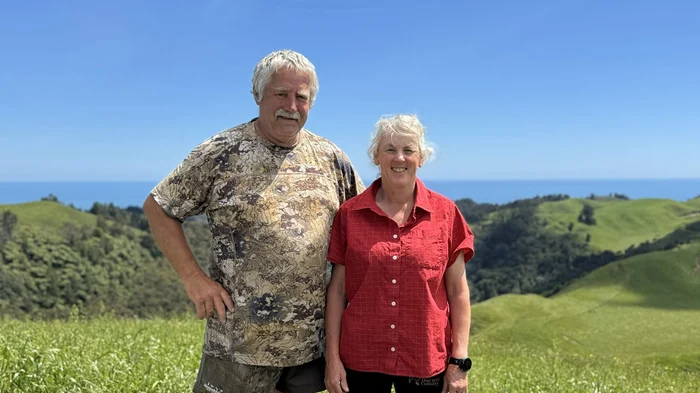
■ Chrissy Weeks and Tony Lumsden, Ratahi Holdings, Matatā
This beef operation is a great demonstration of how simplicity and stewardship benefit both livestock and the landscape by balancing high-performance animal husbandry with deep environmental respect.
Ratahi Holdings operates across two properties – one hidden in the hills above Matatā township and the other on Matakana Island.
For the past 21 years, farm manager Chrissy Weeks and partner Tony Lumsden have operated the business for owners Donald Johnstone and Jay Weeks.
The 544ha (316ha effective) operation has been refined during that time and today it features a 250-cow beef breeding herd.
Weeks’ approach to animal husbandry stood out to the judges for its empathy and attention to detail. Her high level of care has delivered tangible results, including a remarkable farm record of 22 sets of twins from just 180 cows.
By breeding all replacements on-farm and growing all their own supplements, the team maintains total control over quality and biosecurity.
Environmental stewardship is hands-on and personal. The farm operates its own nursery, where the team cultivates native plants often rescued as seedlings from vulnerable areas of the property.
Weeks personally handles pest control across 200 hectares, demonstrating a commitment that goes beyond standard compliance.
Land management is dictated by topography and climate. For example, to mitigate erosion, detention bunds have been constructed to slow water flow.
Sensitive, steep areas are grazed only once a year to minimise soil damage, while stock movements are strictly planned depending on rainfall and ground conditions.
The judges praised the couple for their open mindsets when it came to trying new, innovative farming practices and for opening the farm gates to cater to regular visits from hunters and trampers.
At Ratahi Holdings, success is measured not just by beef production, but by the enduring health of the land being cared for.
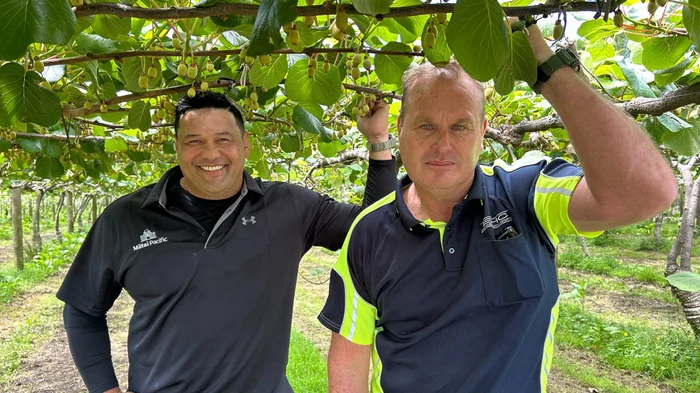
■ Charles Russell and Tom Heeney, Mātai Pacific Iwi Collective
For this Bay of Plenty kiwifruit operation, the land is viewed as far more than a commercial asset. It is taonga tuku iho – an intergenerational treasure.
Spanning over 224 hectares and with a productive canopy of more than 101 hectares, the business is proving that significant commercial scale and deep cultural stewardship can thrive in unison.
Mātai Pacific Iwi Collective is a strategic venture between Te Arawa Group Holdings, Ngāti Awa Group Holdings, and Rotomā No 1 Incorporation. The partnership was established in 2018 to hold kiwifruit investments and to build prosperity over time for the three partners.
Operating across 14 separate titles, the orchards produce a mix of Gold and Green kiwifruit and are collectively governed by a single board of shareholder and independent directors.
The business is driven by a clear vision: to cultivate a legacy of prosperity that honours the mana of the iwi. This philosophy moves beyond simple economics by embedding the values of toitūtanga (sustainability) and kia pono, kia tika (integrity) into daily operations.
The ultimate goal is to safeguard the orchards, ensuring they remain productive and ecologically sound for future generations.
The commitment to conservation is visible across the landscape. In 2025 alone, the team established 13,000 native plants, expanding on years of significant wetland creation and riparian restoration.
The orchards also serve as active research grounds, having hosted scientific trials on native pollinators since 2019 to better understand the ecosystem.
Innovation plays a crucial role in their environmental strategy.
For example, a waste minimisation initiative has resulted in 450km of growing string – used annually to train vines – being collected during winter pruning and recycled into plastic pallets.
In addition, the collective uses cutting-edge technology for land care, including the development of drone-based pest plant management.
By actively managing greenhouse gas emissions and expanding native plantings under the Emissions Trading Scheme, Matai Pacific Iwi Collective is setting an industry benchmark for excellence.
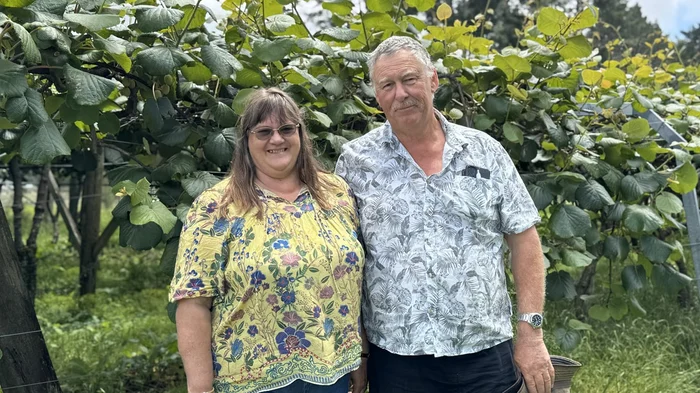
■ Duncan and Julie Aylwin, Treyford Holdings, Katikati
For two decades, this couple has operated their 10.5ha property with a clear strategy – to leverage the commercial success of high-value horticulture to fund extensive ecological stewardship.
Duncan and Julie Aylwin have successfully turned their kiwifruit orchard into an economic engine that drives significant sustainability initiatives, proving that intensive production and environmental restoration can coexist.
The financial backbone of Treyford Holdings is a 1.1ha canopy of Gold kiwifruit that produced 16,000 trays over the past season.
With new grafts coming online, the orchard provides the capital necessary to retire marginal land, which the Aylwins have dedicated to native restoration.
The result is a landscape transformed by nearly 6000 native trees. Large-scale riparian plantings feature kahikatea and kauri, with their growth supported by the active trapping of possums and rats.
The ecological payoff is clearly visible. The property’s waterways are clear enough to support watercress, while the return of tui and kōtare (kingfisher) signal the property’s recovering biodiversity.
The judges said this work would continue to improve wildlife habitat, carbon sequestration and overall landscape resilience.
Beyond the vines and trees, the Aylwins have a smart, circular approach to diversification.
A small beef herd grazes the pasture, integrated into the system through resource efficiency – for example, low-quality kiwifruit is utilised as high-energy stock feed.
The livestock operation prioritises animal welfare, with calves left with their mothers for extended periods to ensure robust development.
With the land thriving, the couple’s focus is shifting toward the future. Succession planning is well under way, with their son, Scott, becoming increasingly involved in operations.
By bringing in the next generation now, the family is ensuring that both the business acumen and environmental vision cultivated over the past 20 years will continue to thrive.
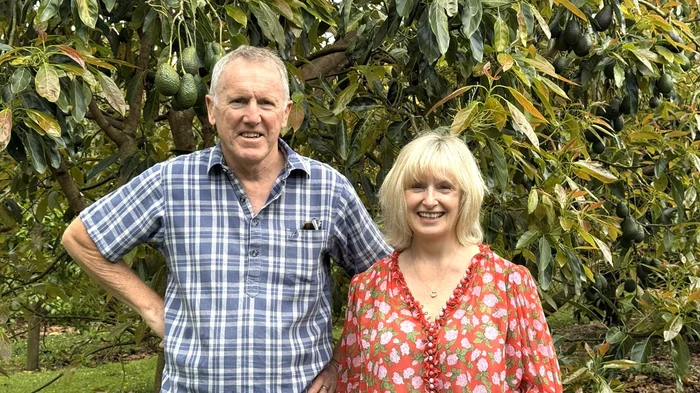
■ Alistair Niven and Carol Palmer, Pakari Orchard, Pahoia
The couple behind this Bay of Plenty avocado orchard are executing a low-input, high-return strategy that successfully balances intensive production with deep environmental stewardship.
Alistair Niven and Carol Palmer purchased the 2.6ha (2ha effective) property in 2020 and, since then, have transformed Pakari Orchard into a model of modern, resilient horticulture.
The orchard’s main income is derived from five-year-old and established 25-year-old avocado trees, however, this revenue stream has been diversified.
By utilising the space between young avocado rows to grow passionfruit and other crops, the productive potential of every square metre is being utilised. This proactive diversification ensures steady income regardless of single-crop market fluctuations.
The property features numerous data-driven sustainability initiatives. The couple’s new sustainable home is maximising nature, with one initiative to capture rainwater and funnel it into two 30,000-litre tanks for fertigation and irrigation.
On the ground, they strictly limit machinery use to prevent soil compaction, plus employ a “monitor and measure” approach to nutrients – using soil and foliar tests to minimise chemical inputs.
Addressing the challenge of stormwater management on a sloping block, the couple uses chipped prunings and orchard mulch to contour the land and control flow.
This is bolstered by multi-species buffer strips and recycled wool matting that filter runoff and improve soil structure.
The judges praised this as a great real-world example of the challenges facing a typical Bay of Plenty avocado orchard and how thoughtful, practical solutions can be implemented.
The couple is well connected with their local community and the wider avocado industry.
For example, trials using seaweed sprays and biological controls have been carried out at Pakari Orchard, with results then shared with the wider community.
The judges said that Pakari Orchard was a compelling example of how small-scale growers could leverage data and diversification to build a robust, sustainable business.
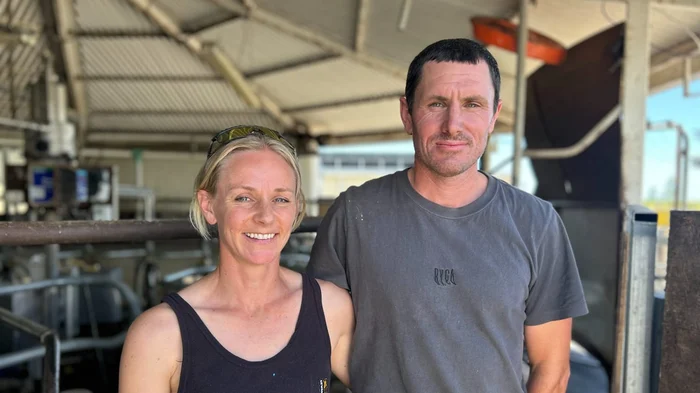
■ Bobby and Anna Dean, Kukuwai Farms, Maketu
KukuwaI Farms is a small dairy operation that is big on environmental stewardship, guided by a philosophy that prioritises conservation, pastures, livestock, and people.
Since taking full ownership in 2022, Bobby and Anna Dean have transformed the 77ha (60ha effective) property into a model of intensive, responsible dairying.
The farm’s proximity to Maketū Estuary has driven a focus on water quality, leading to the planting of 2500 mixed native trees along drain margins and wet areas being fenced off.
This restoration has successfully encouraged the return of indigenous sea rush and creates a thriving wetland buffer.
Operational changes back up this ecological work. The move from stack silage to baleage has reduced nitrogen leaching risks, while solar panels now partially power the milking shed.
Fertiliser is managed carefully, and re-grassing is carried out annually for almost half of the farm – keeping pastures fresh and healthy.
To protect the soil during wet periods, stock is managed in smaller mobs of 40 to minimise pugging and plenty of winter pasture cover is planted.
The judges praised the couple’s good understanding of regulatory requirements and careful effluent management.
When it comes to biosecurity, they’re operating a closed herd system and working on controlling invasive pest plant species.
Simplified systems, family support and an investment in technology are combined with disciplined decision-making to ensure the farm operates on a lean, efficient team structure.
The business is built on a foundation that includes a strong connection to the community. Anna hosts children from a local kindergarten twice a week during calving – providing the young visitors with a first-hand view of farming life.
Judges noted that Kukuwai Farms has successfully found a balance between conservation and profitability.
These strategies are ultimately reducing the farm’s footprint – proving that a genuine desire to care for the wider environment can drive resilience in a modern dairy business.
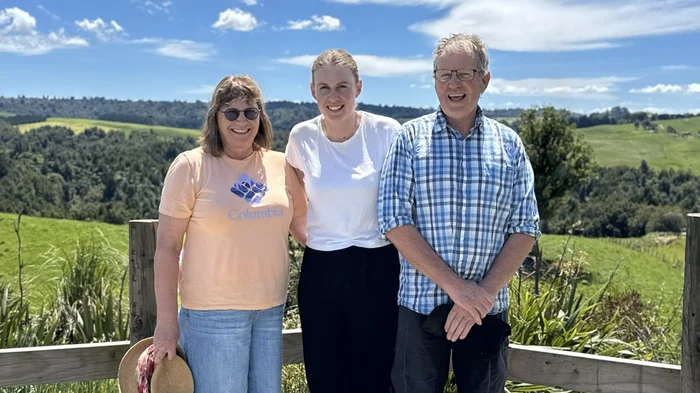
■ Niamh Mark, Peter Mark & Megan Richards, Te Ranga Pamu Ltd, Te Puke
Te Ranga Pamu dairy farm demonstrates how exemplary leadership can merge profitability with environmental stewardship – ultimately ensuring the land looks set to thrive for future generations.
Owned by Peter Mark and Megan Richards, the 170ha (127ha effective) property is being managed by daughter Niamh Mark. The Mark family has been farming parts of the land for about 100 years, with Niamh representing the fifth generation on the Bay of Plenty property.
The operation transitioned from sheep and beef to dairy in 2014 and today runs about 275 Jersey cows across a 100ha milking platform. The team milks once-a-day to average 319kg of milk solids per cow annually.
The steep terrain has prompted sophisticated management, including the recent installation of a composting barn that provides shelter and significantly reduces the risk of soil damage and nutrient leaching. Solar panels on the cowshed roof further contribute to reduced environmental impact.
The team has implemented a virtual fencing system that manages grazing patterns and monitors cow health and behaviour. In addition, drone technology is used for precise weed control, improving efficiency across the property.
Sustainability is deeply integrated into the farm’s structure. Over the past four years, the family has planted about 10,000 native trees on steep, unproductive land, aiming to create a vital wildlife corridor that could eventually link regional kōkako breeding groups.
The team’s commitment to biodiversity is backed by intensive pest control efforts across the property and neighbouring areas. It’s further illustrated by the development of a “bush classroom” which is used by local primary school students for environmental studies.
Succession planning is equally robust, moving the business structure from a partnership to a company to allow future generations to hold shares in Te Ranga Pamu.
The judges praised this, saying it provides a transparent, long-term framework for family continuity.