
Ōpihi trustees have day in court
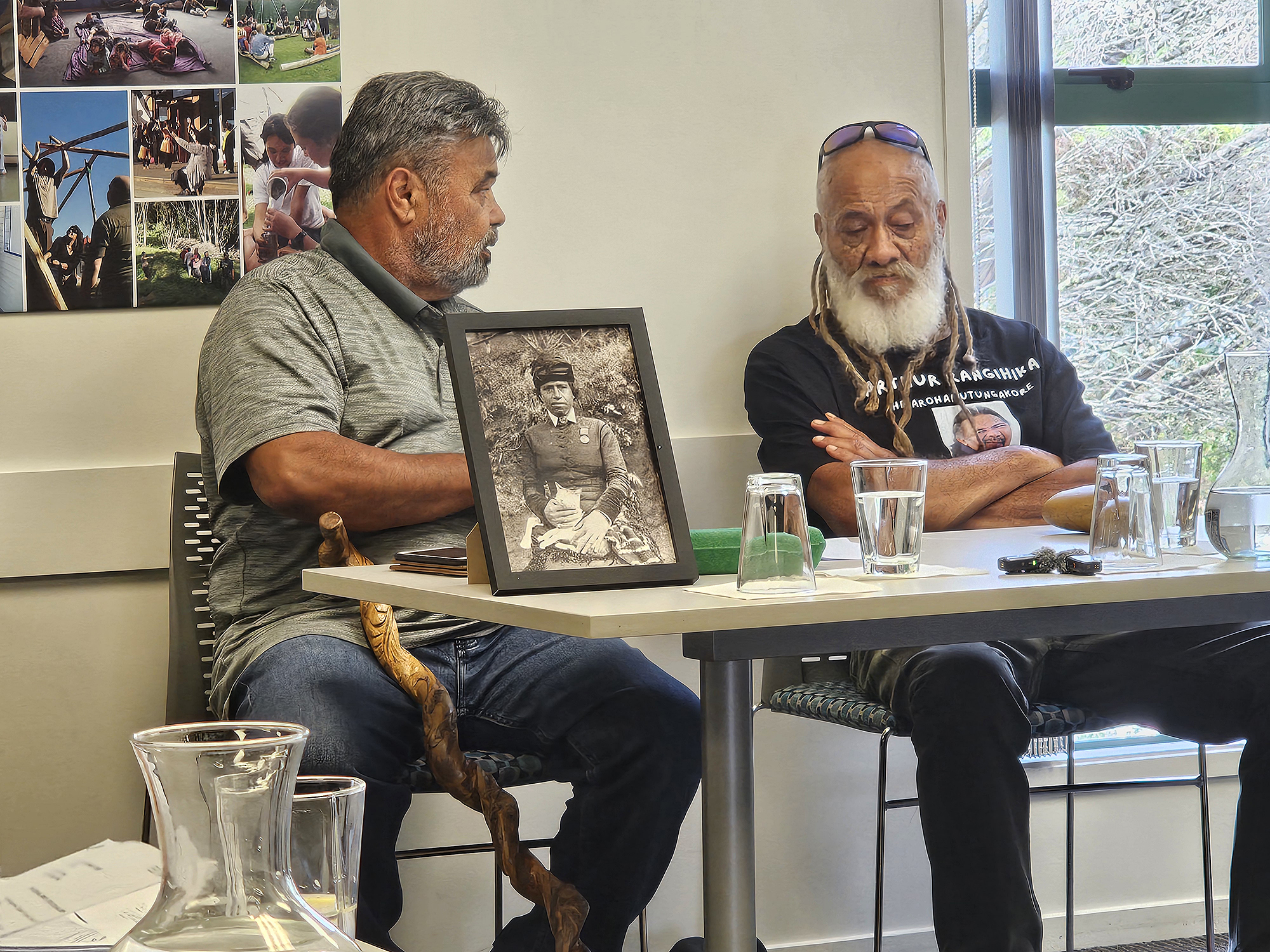
Support: Ōpihi Whanaungakore trustees Hemi Hireme and Rapata Kopae with a photo of Guide Kate, famous for rescuing several people during the Tarawera eruption, and who was buried at the urupa after having lived to 100 years of age. Photo Diane McCarthy E5959-01
Diane McCarthy
“The harm you cause by holding a bone in your hand is irreversible,” Ōpihi Whanaungakore trustee Hemi Hireme told the Environment Court this week.
The hearing, at which trustees of the ancestral urupa opposed Heritage New Zealand Pouhere Taonga’s archaeological authority for residential development at Piripai, was held over Tuesday and Wednesday at REAP House.
Speaking about the provisions in the authority for protocol around the discovery of koiwi (human remains), he said, “if you are finding koiwi, it’s too late”.
“When you’ve got a bone in your hand, it’s too late.”
While a 56‑acre (22.6 hectare) lot at Piripai was vested to Ngāti Awa trustees in 1878 as a native burial reserve, the current trustees maintain that the area where early Māori settlers were buried does not stop at the 56 acres.
“That 56 acres was an arbitrary colonial line,” Mr Hireme said.
Mr Hireme told the court he believed Ōpihi Whanaungakore stretched for 600 acres from Turuturu Roimata (The Statue of Wairaka at The Heads) to Ohuirehe. It was where eponymous ancestors of Mātaatua were buried and where their spirits returned from ancestral homelands of Hawaiki when called to come back by karakia and karanga.
“That place is ahu wairua. We don’t know how those people can live there,” he said.
“It’s like a bank, not with money but full of wairua. When we look at Ōpihi from across the river we’re filling our bank up, of wairua, of soul, of positivity, of love. When the bulldozers come in, you are destroying that.”
He likened it to destruction of Iraq’s Mosul Museum artefacts by Islamic State in 2015.
“ISIS went into their museums and smashed their taonga because they couldn’t bear people living in co-existence.
“When we look at what they are proposing to do at Ōpihi Whanaungakore, that’s our Mosul. That’s what it feels like ... you are destroying half of who I am, you are destroying my soul.
“For 23 years we have been coming to court with one goal, to protect our souls – everything that gives us a sense of being.”
Mr Hireme was supported on the witness stand by fellow trustee Rapata Kopae, who was not permitted to give evidence.
He brought with him a photograph of Guide Kate, (Keita Rangitūkia Middlemass) who was buried at Ōpihi Whanaungakore in the 1920s and a carved tokotoko belonging to the late Māori leader, Maanu Paul, entrusted to him by Mr Paul’s widow.
The case was heard before a panel headed by Judge Jeff Smith, and including Judge David Cauldwell, and Environment Commissioners Glenice Paine and Shona Myers.
It involves the 26.9ha Whakatāne District Council-owned block next to the official urupa site. The council entered into a sale and purchase agreement with developer MMS GP in 2017, which became unconditional in 2018.
Because the sale is subject to gaining consent, the sale has not yet settled, however, MMS GP is still contractually bound to the purchase.
Heritage New Zealand granted Archaeological Authority prior to the district council granting consent for the development.
Te Runanga o Ngāti Awa, Ngāi Taiwhakaea and Ōpihi Whanaungakore appealed the Archaeological Authority and the hearing scheduled for 2022 was adjourned for the parties to come to an agreement out of court.
MMS GP director Bain McDonald told the court on Wednesday that he had requested the adjournment in order to readdress these matters.
“We didn’t want to keep battering away through the courts. We wanted to resolve the matter,” Mr McDonald said.
Working with the rūnanga and the council, they had agreed to a compromise and the rūnanga and Taiwhakaea had since withdrawn their appeals.
A modified plan for the development now included half the usable land area of the original 240 lot development and included a 300-metre buffer zone between residential developments and the urupa. Two other buffer zones were included between the conservation wetland to the south and the coastal area to the north.
Ōpihi Whanaungakore trustees had not been involved in the agreement and maintain their opposition to the development.
Counsel for the trustees Max Harris said Heritage New Zealand had made significant errors in granting Archeological Authority.
He said there were two ways the court could approach the case, either by remitting the decision back to Heritage NZ with the recommendation that it go to a full Māori Heritage Council, or reverse the granting of the authority.
The preferred decision of the trustees was that it be put before the full Māori Heritage Council, which had specialist expertise in safeguarding Māori heritage.
Although there were no known archaeological sites, Mr Harris said Heritage NZ’s internal assessment had identified that the development had the potential to uncover subsurface archaeological artefacts of early Māori settlers, therefore should have been put before the council. “The (Heritage New Zealand Pouhere Taonga) Act is quite clear when matters need to be referred to the council.”
Even by Heritage NZ’s own criteria, it should have triggered a referral to the council, he said.
Although the application had provided cultural impact statements from Te Rūnanga o Ngāti Awa and Ngāi Taiwhakaea, Ōpihi Whanaungakore trustees had not been given an opportunity to provide one.
Mr Hireme learned of the application after it had been made and placed two phone calls to Heritage New Zealand to tell them the trustees were opposed to the development. He had not been contacted until he learned of the decision.
“Some engagement with Ōpihi Whanaungakore trustees could have assisted in informing Heritage NZ on the relationship between Māori and the site,” Mr Harris said.
Heritage NZ incorrectly recorded that it had received a cultural impact statement from the trustees. It also recorded incorrectly that the parties did not oppose the Archaeological Authority.
Judge Smith agreed that while the parties had indicated they wished to be involved if any discovery of archaeological artefacts or koiwi were discovered during excavation of the site, that could not be interpreted as approval.
Counsel for Heritage NZ Stephanie De Groot said Heritage NZ accepted it had made the errors.
However, she pointed out that under the Act, it had no requirement to consult.
The senior archaeologist who carried out the archaeological assessment, Dr Rachel Darmody, gave evidence that she had taken both calls from Mr Hireme and in both cases had escalated these to the appropriate people in the organisation.
Heritage NZ acting chief executive Dean Whiting told the court that although he thought Mr Hireme’s latest statement provided greater understanding of the importance of the site to Māori, he did not feel that it would have made a difference to the decision to grant Archaeological Authority.
Counsel for MMS GP Vanessa Hamm drew the court’s attention to the 2002 Ngāti Hokopu ki Hokowhitu vs Whakatāne District Council case pertaining to the same urupa.
At the time, Te Rūnanga o Ngāti Awa had wanted to situate the Mātaatua meeting house on the site.
In that case, Sir Hirini Mead, then chairman of the rūnanga, defined the extent of the urupa as being within the vested reserve. He had expressed the opinion that it was extraordinary because it is so large and that most wāhi tapu were small.
Judge Smith accepted that colonial surveys of the area may not have been done in consultation with tangata whenua.
“The urupa was determined by a European surveyor and I accept there may have been some errors in that.”
He said some people used the term wāhi tapu for areas that were culturally significant for Māori but did not fit with the legal definition of the term.
He said that use of the area as a place for fishing, birding, eeling and other activities did not suggest to him that the entire area was wāhi tapu.
“You couldn’t do that if it was entirely tapu.”
The panel deferred their decision to a later date.
Judge Smith commented on the complexity of the case.
“Clearly, we have some deliberating to do. While we try to deliver a decision within three months, I won’t guarantee it on this occasion because of the complexity,” he said.
No issues wit hikoi - police
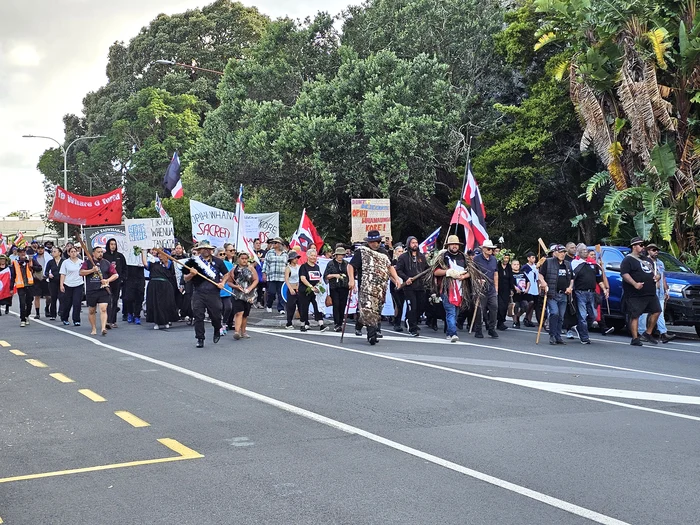
Police have praised the behaviour of those participating in Tuesday’s hikoi through the town centre, held in support of the Ōpihi Whanaungakore trustees’ appeal to the Environment Court that was opening that day.
Senior Sergeant Cam Mackinnon said there was “good organisation” from those behind the hikoi and it was pleasing to see good behaviour from the crowd marching, and from the general public.
The event concluded without incident, with no disorder reported, thanks to strong cooperation from organisers, clear traffic management, and public patience.
“A couple of roads were blocked, so we appreciated the public’s patience,” Mackinnon said. “Without the support of the public, we wouldn’t be able to have events occur in such a smooth and seamless fashion.”
Traffic disruption lasted around one hour, with detours in place.
Police coordinated with council roading staff to put in place a traffic management plan.
“The primary police focus was making sure the community was safe and that no disorder arose.
“Roads were closed so everyone was safe.
“Everyone got decent directions on where to redirect their vehicles. From a police perspective, it went well.”