
Policy sought over cat plague
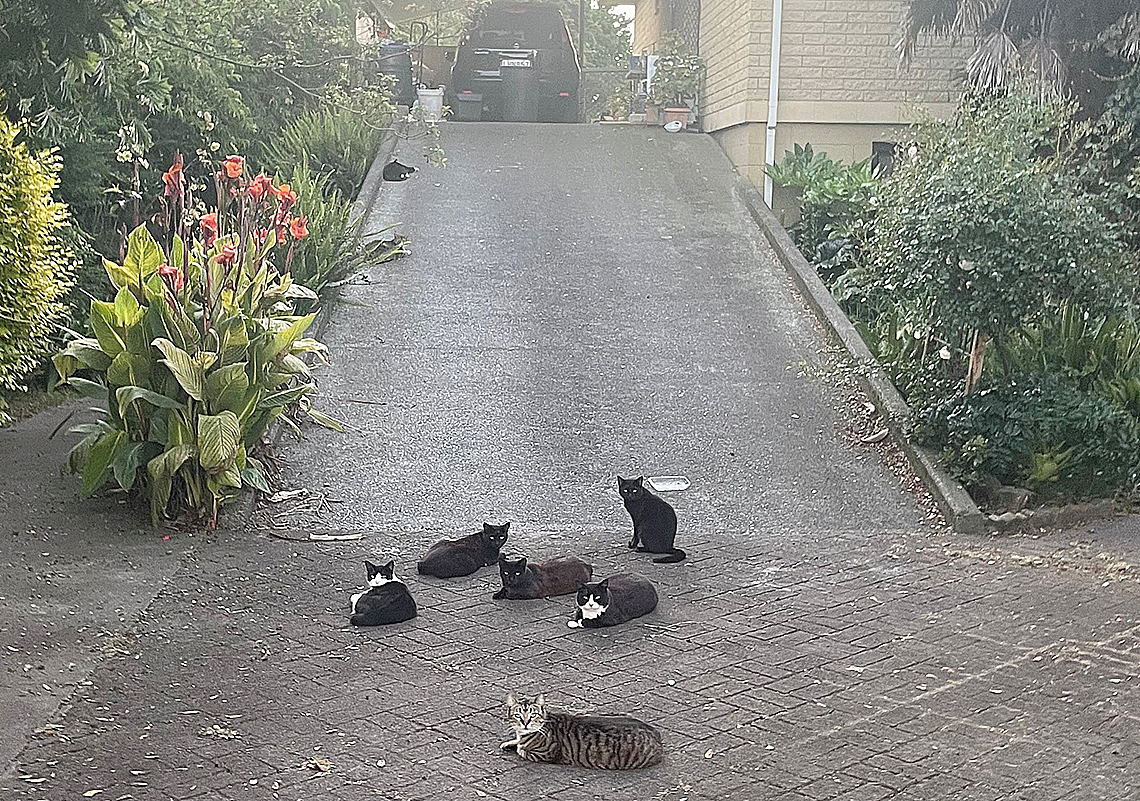
CAT EPIDEMIC: Taken in January, this photo shows at least eight cats basking on a Bracken Street driveway. Photo supplied
Diane McCarthy
Residents whose homes are being overrun by neighbourhood cats have asked Ōpōtiki District Council to instate a policy restricting the number of cats people can own, among other controls.
Neil Ericksen said he had been dealing with issues with stray cats and barking dogs since he moved into his home two years ago.
There have been times when I have found five cats on my patio,” he said.
The fabric of patio furniture he inherited from his mother had been destroyed by the cats. “I have squirted cat repellent, sprinkled pepper around my decking, thrown pots of water and other items at unwanted cats and placed anti-cat mats at strategic locations.”
After setting animal traps loaned to him by Ōpōtiki Society for the Care of Animals (Osca), he caught seven felines in two weeks but it did not solve the problem. “Still, they came.”
The problem seemed to be worst in the Bracken, Union and Bridge street areas, although he had seen as many as 10 cats at one time sitting on the lawn of the Anglican Church in Church Street.
“The person who feeds the cats in our street also feeds those cats. I see stray cats also around the laundromat in Elliot Street and I’m told there is another cluster near Mitre 10.”
Julie van der Veer said Bracken Street had been inundated with cats and kittens over the past 12 months, mostly from one property.
“The property is frequented by the same person that feeds cats all over town. They defecate on everyone else’s garden and urinate on our porches.”
Reg Taia, who lived next door to a property where dozens of cats gather to be fed said the cats entered his home whenever a door was left open.
“We don’t hate cats, but we hate what dozens of cats that don’t belong to us are doing to our properties,” Mr Taia said.
“They chase away and kill the birds that used to frequent our backyard.”
The residents were full of praise for the “very capable” Ōpōtiki District Council animal control team for greatly reducing the barking dog issue. However, they were told there was nothing that could be done about the cat problem because there was no policy within the council.
Mr Ericksen provided research he had done on policies held by other councils around New Zealand, including Whanganui, Palmerston North, Hutt City, Wellington City, Ruapehu and Selwyn.
These varied but could include limiting numbers of cats in a household, compulsory microchipping, registering on the New Zealand Companion Animal Register and desexing and preventing cats wandering outside the home after dark.
He asked that the council adopt a policy that included all of these plus prohibiting feeding cats on non-residential properties and said feral cats were also causing problems outside the town limits. He had spoken to rural people who blamed feral cats for a recent absence of kiwi calling, among other native bird species.
Councillor Barry Howe was in favour of putting a cat policy in place. Councillor Dean Peterson agreed but questioned staff about their capacity to police such a policy.
A staff member said the small team was already stretched with dog and horse control and stock on roads.
Mr Howe suggested just implementing the policy might go some way toward lessening the issue without having to police it.
Chief executive Stace Lewer asked that the elected members consider whether that was something they would like staff to investigate further as the upcoming long-term plan process would be a good opportunity to review it.
Mayor David Moore said central government needed to be made aware of the issues as council staff had enough on their plate dealing with horses and dogs.
“We’ve got a current government that’s making lots of noise about doing core business, and whether dog control is actually core business is even debatable to them, so we need them to step up and do their bit. ”
He said the town was lucky to have Osca.“Without them, we would have a much worse cat problem.”
Osca’s Kathleen Young said there were a lot of unwanted, abandoned animals, both dogs and cats around town.
She agreed that all companion animals should be desexed and microchipped.
“Certainly, that is what we have been working on for the last 15 to 20 years.”
Last year, Osca had desexed about 140 cats and since 2022 had desexed about 180 dogs.
However, she felt the cost to ratepayers for the council to enforce a cat policy would be too high. “I don’t see that ever happening,” she said.
“It is quite a complex problem, and I don’t see an easy solution, to be honest.”