
Sow your seeds movement – a growing vision for Edgecumbe
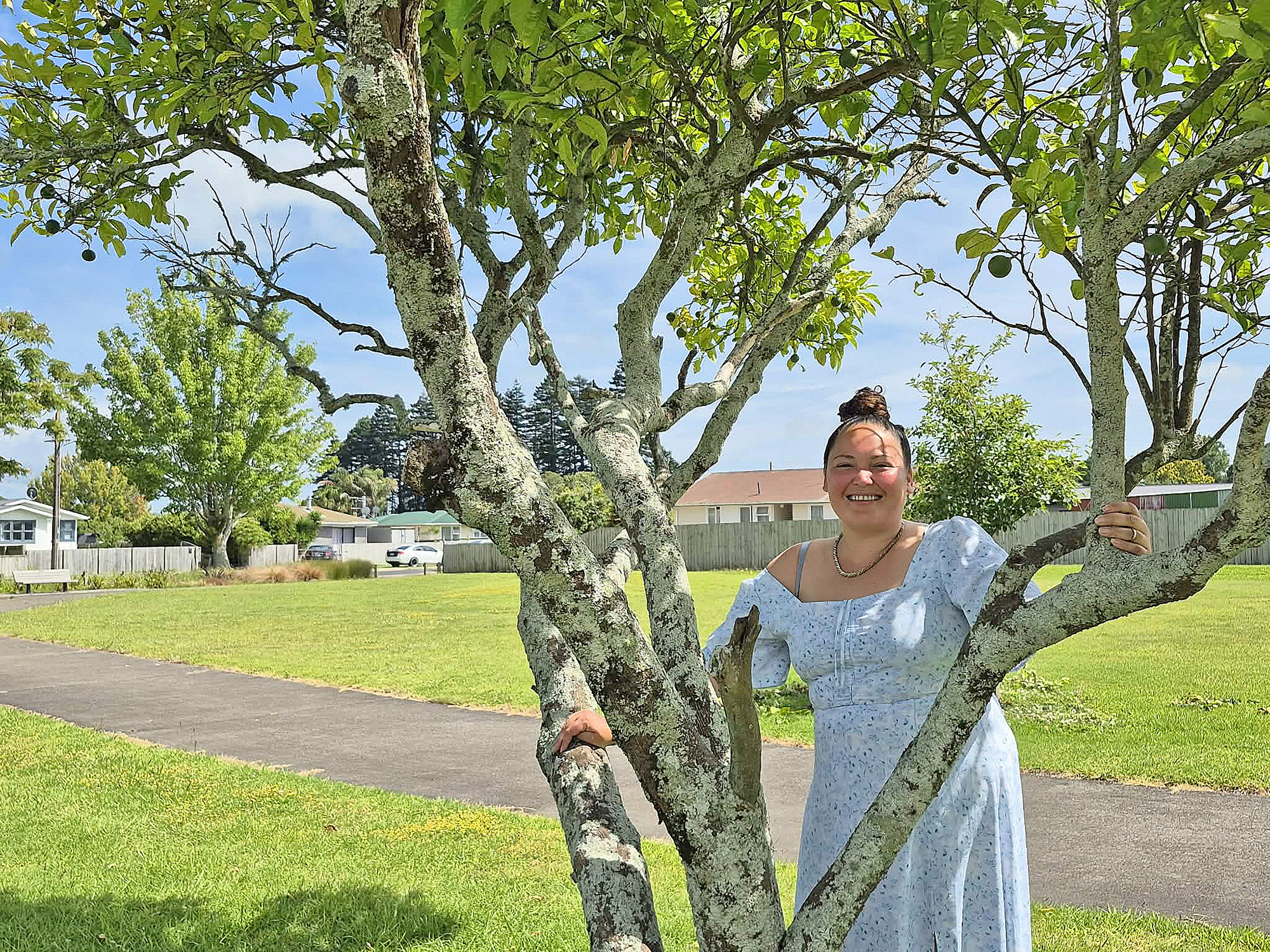
GROWING VISION: Zen Te Moana-Kyle stands beneath a fruit tree in Edgecumbe, where her community garden and food education project is beginning to take root. Photo Tamara Herdman E5836-01
Tamara Herdman
A community garden and food education project is taking shape in Edgecumbe.
Zen Te Moana-Kyle, a chef who recently moved to Edgecumbe from Marton, has been filling the town’s pātaka kai (community pantry) on College Road every Friday using rescued food sourced during her regular travel through Rotorua, Hamilton and Auckland. Through volunteering and networking with food rescue organisations and community kitchens, she collects surplus food and brings back what the Edgecumbe community can use.
“I’m happy to see it get emptied,” she said. “That’s the point – it means people are eating.”
However, Mrs Te Moana-Kyle recognised that the pataka kai is often empty during the week, highlighting a gap in food access. This led to the idea of growing food through a community garden, to support the pātaka kai and to give people something they could take home and be involved in producing themselves.
With a background as a chef, and parents who are gardeners and farmers, Mrs Te Moana-Kyle said the idea of growing food alongside food distribution made sense, particularly as food prices continue to rise.
“As a chef, I see the cost of food going up constantly. It’s getting harder for people to source affordable food,” she said.
She began by growing seedlings at home and shared the idea publicly through Facebook to gauge community interest. People began donating seeds and gardening supplies, along with offers of help.
What began with around 40 seedlings has grown to about 120 plants, along with seven large sacks of donated seeds from local gardeners, farmers, churches, and supporters from outside Edgecumbe.
With the project set to begin in spring, Mrs Te Moana-Kyle plans to allow the plants to go to seed, harvesting them in preparation for next season.
She has been stockpiling supplies while planning the next steps, with raised garden beds and storage racks set up at her Edgecumbe home.
Mrs Te Moana-Kyle said her faith was a driver for the project. She is undertaking a “Daniel fast”, eating only fruit and vegetables, inspired by the diet of Daniel in the Bible, and has been saving fruit and vegetable seeds to grow.
“This is a God-led vision that I had,” she said.
“So, I put the message out, and it’s just taken off.”
Interest has come from a wide range of groups, including gardening clubs, experienced gardeners, farming families, and community organisations. Offers of support have included seed donations, volunteer labour, equipment, printing resources from local libraries, and monitoring support from security workers.
Mrs Te Moana-Kyle has also been contacted by clubs, charities and churches offering assistance to help get the project under way. Farmers have offered tractor assistance, and others have volunteered to help with site preparation and maintenance.
“It’s great to see there is community interest,” she said.
“The vision is that people contribute, participate and benefit. Everyone can eat and everyone can contribute, and it’s not just limited to gardening. We can teach people what to do with the produce. Being a chef, I can teach you what to do with the ingredients. Just hit me up and I’ll give you a recipe.”
Her initial vision was to have the community garden at the College Road reserve, but after discussions with the Bay of Plenty Regional Council and the Whakatāne District Council, and learning that four houses were removed from there after the floods, the site was deemed unsuitable for food production.
Concerns included known areas of asbestos and buried contaminated material from former houses, as well as restrictions on soil disturbance near flood-protection infrastructure. Councils also noted the cultural and emotional significance of the area for families who lost homes in the floods.
She said she supported the decision not to proceed at that site.
“I wouldn’t be comfortable being involved in a food garden where there’s any risk of contamination. Also, families lost their homes in the floods, and attempting to establish a community garden in this location could be seen as insensitive to those who were directly affected, I couldn’t, in good conscience, support that.”
She is now working with the councils and the community to identify an alternative location that meets safety, environmental and regulatory requirements.
While the garden site is still being confirmed, the broader project continues.
Beyond growing vegetables, Mrs Te Moana-Kyle plans to incorporate food education, including workshops on cooking, preserving, baking and bread making. She sees this as an essential part of improving food security.
“The whole plan is to create foods that are affordable and can feed the family, and bread is one of them,” she said. “It’s a staple.”
The long-term goal is to create a system where people contribute, participate and benefit – through growing, sharing knowledge, and accessing food.
Community members interested in supporting the project can follow updates through the Sow Your Seed Movement Facebook page. Donations of seeds, tools, and volunteer time are welcome, Mrs Te Moana-Kyle can be contacted by email at [email protected]