
Volunteers run civil defence hubs
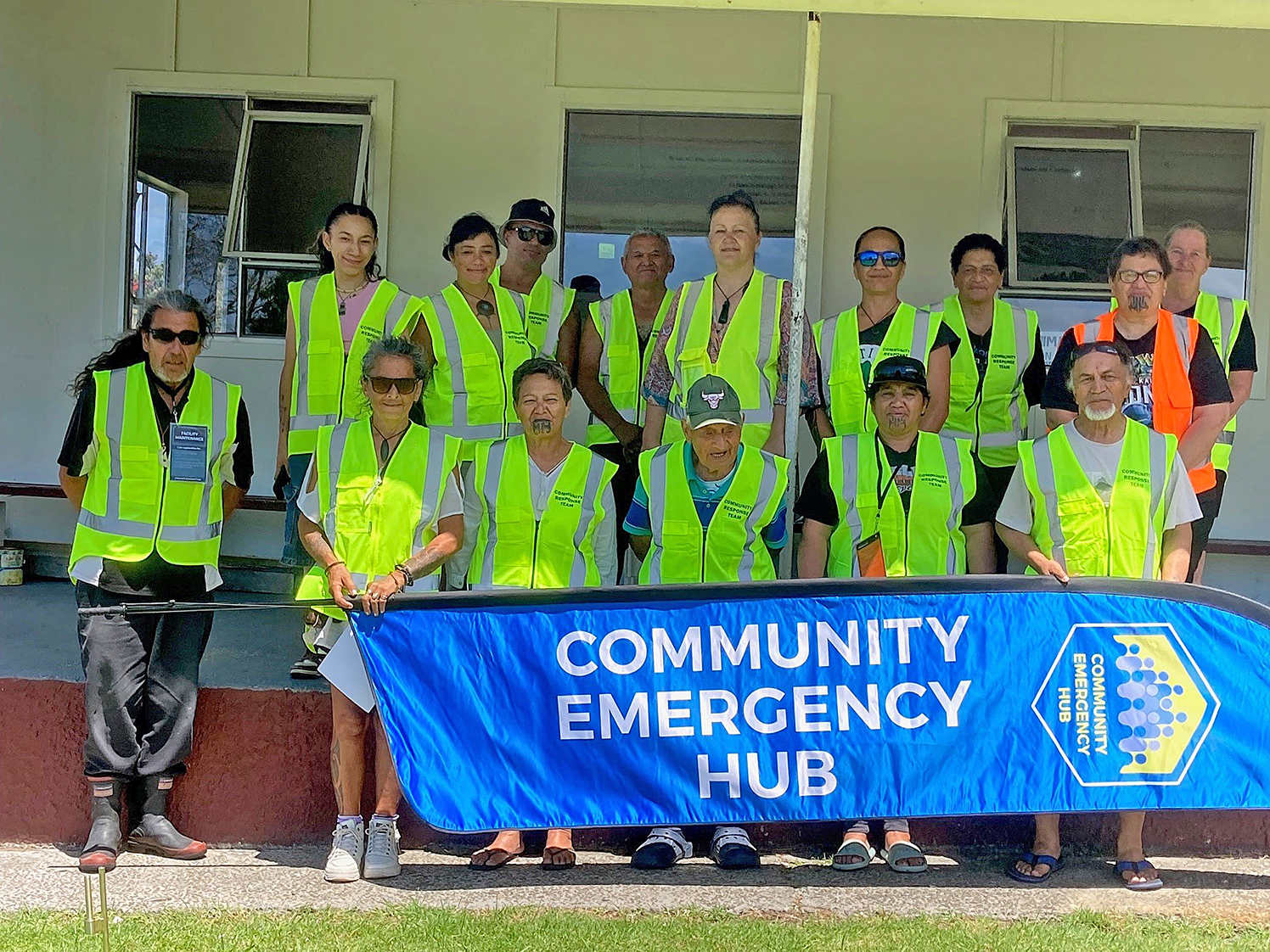
PREPARING FOR ‘D’ DAY: Front row, from left, Gavin Paterson, Fiona Waitemata, Gaylene Kohunui, Te Urikore (Pop) Tuari, Juanita Aramoana, and Mohi Kohunui. Back row from the left, Jamie McCormack, Bridget McCormack, James Moa, Mac Rewiri, Kelly Tuari, Georgina Kohunui, Marlene Tuari-Hape, Ngaire Ngamoki, and Maree Carmichael. Absent, Graeme Tuari, Colin Ngamoki, Anthony Carmichael, Haami Aramoana, Dawn Curtis, Natasha Ransfield, Stevie Klock, Edward Tuari, Elizabeth Munroe Tuari, Trevor Ransfield, Christine Martin. Photo supplied
Paul Charman
Roimata Marae hosted the district’s first community emergency hub training seminar for volunteers this week, an event supported by Emergency Management Bay of Plenty and Ōpōtiki District Council.
Ngaire Ngamoki co-ordinated the training after consultation with whānau following the July flood event in Kutarere and surrounding areas.
Ms Ngamoki has been involved in civil defence for many years and has conducted community exercises with the Mokoia Community Association, Tatau Pounamu and The Red Cross (Rotorua).
About 100 motorists were stranded in the July floods following the closure of State Highway 2 and Wainui Road.
Twelve whānau members from Roimata Marae were dispatched to the highway to ascertain their needs ahead of the motorists being taken in by Kutarere Marae.
“Our whānau provided water from our community resource hub, funded by the Cyclone Gabrielle Fund, and we offered information and reassurance to whānau who were stranded,” she said.
Since the flooding there have been several community hui with whānau from the Waiotahe, Wainui, Kutarere, and Roimata areas to identify the gaps in the support received from Ōpōtiki District Council Civil Defence.
“The idea was to learn what we could have done differently to better support our community in the future,” Ms Ngamoki said.
“Our training seminar was one of the first steps toward training people to build on their current skills and knowledge sets, to enable us to work more collaboratively together, when the next civil defence emergency happens, which we know is inevitable.
She said communities would need more emergency hubs because of climate change, but they did not have to be marae, which had traditionally carried the brunt of civil defence emergencies.
“They can be set up by clubs and other groups. They are primarily a place where whānau can come and receive information, assurance and a cup of tea with a friendly team.”
In living memory, she said the Eastern Bay had experienced more than its share of natural disasters, including the 1987 Edgecumbe Earthquake, Cyclone Bola the following year, many floods and the eruption of Whakaari/White Island.
“Things can go wrong rapidly and at a large scale here, and we won’t always be able to depend on emergency services to care for us,” she said.
“So, it is essential to build leadership within your community, identifying the strengths, resources, and assets we already have and build upon them.
“As for Māori, we are on the front line all the time and do what we do as part of manaakitanga (Māori concept centered on hospitality, kindness, and reciprocal respect). But our people need additional training and resources to consolidate and enhance the effectiveness of what they naturally do.”
She wants to see whānau empowered to look after themselves and others and encourages them to “bang on doors” if necessary, to get the funding they need to do so”.
She is grateful to Kutarere Marae for consistently opening its doors, especially in times of flooding and offering manaaki and aroha over many years.
“In addition, Kutarere School which has always been there to support the Kutarere community and the Roimata Civil Defence Response Team of volunteers who are leading the way, for their community in this space.
“A special mention to the ODC Civil Defence Team Tina Gedson and Maia Calcoutt for providing the support necessary, to enable us to continue with this mahi. Nā te rourou, nāku te rourou, ka ora ai te iwi.”
Meagan Edhouse from Emergency Management Bay of Plenty said during a disaster, when official services were often stretched, communities would naturally come together to support each other. “Hubs are community-led, with each community group making it work for their own set of circumstances and their own volunteers.
“At its simplest, the concept is neighbours coming together to help each other in a co-ordinated way rather than officials deciding who should do what.
“As we have seen, even in recent emergency events, marae are often the default ‘community hubs’ in our communities. It’s a way of creating a place people know and can go to ask for and offer help, share resources and skills, find information and updates, be in the company of other people facing a similar situation, even start the process of organising clean-up and getting back on their feet.”
Ms Edhouse said people could get in touch with the council if they wanted to establish a Community Emergency Hub.