
Opinion: 'Refreshed' council - different mindset to spending control?

.
■ Our new mayor recently wrote an opinion piece, “We’re in this together”. He wants to be a mayor of all the residents in our district. He has quite a job to do because he received only 29 percent of the votes, writes Whakatāne Action Group’s Peter Minten.
If one keeps in mind that just short of 50 percent of the eligible voters took the effort to use its democratic right, our new mayor, Nandor Tanczos, represents just below 15 percent of us all. Not a strong mandate we would say.
In his piece, he acknowledges that Whakatāne District Council rates hurt people, but says it is not easy to keep rates affordable.
As WAG, we decided to help him a bit with this.

Example one: Council briefing on Wednesday, November 19
Council staff provided an update on the Three Waters delivery plan. One of the slides showed the council used two consultancies to review the Capital Expenditure (CAPEX) Plan for Three Waters.
According to the their websites, those consultancies, Taylor+Tonkin and BECA, operate within the same expertise. So, why did the council need two? It is obvious those consultancies don’t come very cheap, and why was it necessary? Doesn’t the council employ staff with the right skills or council management doesn’t trust the opinions of its own staff?
On another slide, staff presented that the imminent focus of the council is on establishing a transformational organisation to set up the council-controlled organisation (CCO) that will run Three Waters in Whakatāne. Nic Johansson has been appointed director and with a title like this, one knows he doesn’t come cheap. Also, one of his direct reports appeared to be a contractor. A conservative guess from us is that those two will raise the bill by $400,000 a year.
Whakatāne District Council employs more than 300 staff. Why is it not able to transform the Three Waters department to a CCO? Why do we need contractors and consultants?
What is the general manager planning, regulatory and infrastructure, David Bewley, going to do? The organisation is taking about 50 percent of his job away.
Focus on delivery for Whakatāne residents, I heard the mayor say.
Agree, there is a massive job in front of councillors and staff.
Maybe council should focus on delivery for Whakatāne residents.
The annual report non-financial measures shows that only 40 out of 69 performance measures were delivered. WAG call that result a C minus.
The council has 19 groups of activities as set out in the 2024-2034 Long-Term Plan. Each activity group has performance measures on which we report, with 69 in total.
There are 33 mandatory measures set by the Department of Internal Affairs; the remaining measures selected by the council as a meaningful way to report on our intended level of service.
In summary, the performance measure results show:
n Targets were met for 58 percent of all performance measures (40 of 69)
n The council achieved 73 percent of the mandated measures (24 of 33)
n The council selected measures achieved only 44 percent (16 of 36), meaning that the intended level of service delivery is perceived very poorly. One could conclude the council is failing its residents.
Below is a summary from the 2024-2025 Annual Report showing where the council did and did not deliver.
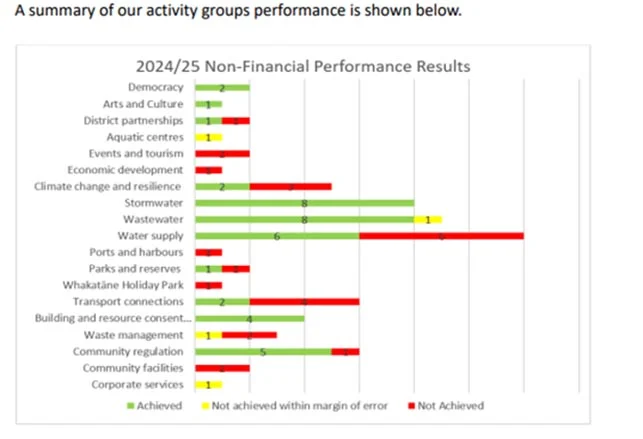
Items and issues that have a direct impact on the lives within the district, are not delivered upon. And that is after all those rate increases, which were argued for because of the required “increase in service”. Where is value for money?
The mayor, councillors and staff should start focusing on delivery for residents and maybe consider the sale of the Whakatāne Holiday Park after another negative cashflow year of $491,000 because of poor patronage. At least one “not achieved” will disappear, and we could afford those new hotshots in our Three Waters transformation team.
So, Mr Tanczos, plenty of work to do. Yes, we acknowledge we are in this together, but also, we believe hard questions for council staff are not asked. Why was the CCO transformation set up in this way?
Why couldn’t the council’s manager do this job? Why did we need the services of two consultancies to review all future Three Waters CAPEX? Was one not enough?
These are the questions your refreshed council should ask the chief executive and council staff but, based on the result of the elections, most were co-responsible for the rate increases of the past three years and the increasing debt and are still occupying the seats.
At the start of this new triennium, we are using more consultants and we keep losing oversight of council budgets. See below the result of council oversight for the CAPEX budgets of wastewater.
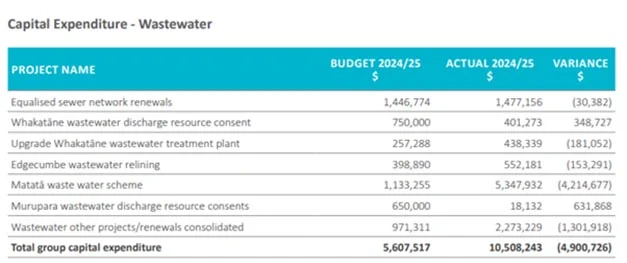
Resource consents’ work has to be done and is not savings. That money will be spent this or next year.
Note that all wastewater projects have a significant overspend (38 percent to 116 percent) of which only the Matatā one is explained in detail (Tahi Hill farm purchase and remember it has been bought before; there is a resource consent for what it is supposed to do).
Did anybody around the council table ask about this?