
Predator jailed for 16 years
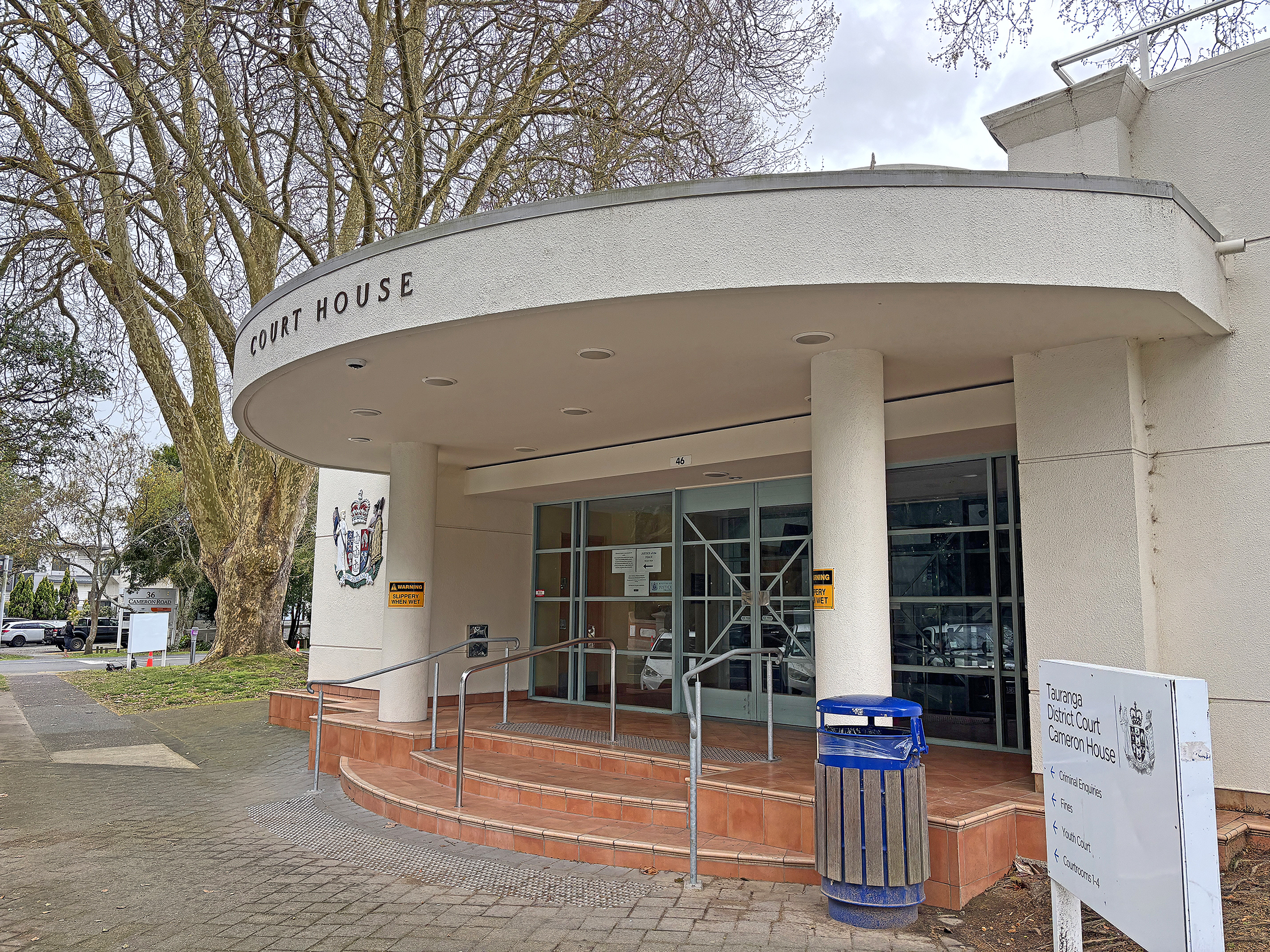
SENTENCED: Victims of a repeat sexual offender received closure when he was sentenced at Tauranga District Court on Friday. Photo Brianna Stewart E5641-01.
Brianna Stewart
The lengthy imprisonment of a sexual offender – whose abuse spanned nearly two decades – offers some certainty to the multiple victims who are trying to move forward in their lives.
The four young women were subjected to repeated sexual abuse while they were in the former Whakatāne man’s care as children.
Interim suppression orders prevent the Beacon from naming the man while he is awaiting trial in a different region on similar, but unrelated, charges.
The 43-year-old was sentenced by Judge Thomas Ingram at Tauranga District Court on Friday to 16 years in prison.
A jury in the same court found him guilty in May of 22 sexual violation charges and one of making an intimate visual recording.
The defendant maintains his innocence, claiming he has been set up by an ex-partner.
His Bay of Plenty offending spanned 18 years from May 2003 to December 2021 and included multiple counts of unlawful sexual connection, indecent assaults and one attempted rape.
The victims were as young as four when the abuse started. They all have automatic name suppression as victims of sexual offending.
Many of the charges were representative, meaning they related to more than one specific incident.
The court heard that one victim was offended against between 200 and 300 times.
One woman read her own victim impact statement aloud in court, speaking directly to the defendant, who appeared by audio-visual link from prison.
She said from the ages of six to 12, she was repeatedly abused by someone who was meant to look after her.
While she was too young to speak up at the time, she said his actions were deeply wrong and made her feel trapped.
“You stole so much from me.”
The abuse had physical impacts and lasting mental ones. She still struggles to feel safe and relax, even when she knows there is no danger.
She described the pain, shame, confusion and fear that the offending caused.
“No child should have to carry those feelings, and no adult should have to heal from them alone.”
She said that even though she will never get a chance at a normal life, she forgives him.
While his actions were “evil” and “life destroying,” she refused to carry his shame anymore.
Three other victim impact statements were read by the Crown prosecutor.
The second victim said she was regaining her mana after holding the burden of the abuse for many years.
She described feeling sickened to learn that she was not the only one who was abused by the defendant.
“We were all little girls, all assaulted.
“A jury found you guilty of all 23 charges. How did you think you could get away with it?”
The third victim, the man’s daughter, said he stole her childhood, her innocence and her whole life.
His abuse had long-reaching impacts, contributing to her making poor decisions and developing mental disorders including post-traumatic stress disorder (PTSD) and persistent depressive disorder (PDD).
She described having to parent her siblings before she got to be a child herself and taking on more work as a deliberate move to avoid being home with her father.
“You were the one person who was meant to protect me, but you single-handedly destroyed that.”
The final victim impact statement told how the fourth victim suffered the abuse silently for years, permanently altering the person she was supposed to become.
She described the defendant as a predator and a narcissist who must be stopped. She said he destroyed something sacred inside her.
She attended the sentencing on Friday both for the woman she is today, and for the young girl she once was.
The victim said she was afraid to speak about the abuse and buried her pain, hoping it would go away.
“But trauma doesn’t disappear, it festers.”
She said the multiple mental health conditions she now had were not labels but chains. Her social life had disappeared, and she had to stop working because of the constant fear.
She worried about the next generation and said she was determined to protect her daughter from the darkness of her own past.
But she said she was not broken and would heal despite her abuser.
She hoped the sentence would mean he would never lay his “evil hands” on another innocent child.
Her statement ended with the whakatauki (Māori proverb) “ka whati te tī, ka wana te tī, engari ka whati te tangata hara, ka kore e tupo āno.”
Translated, “when the cabbage tree is broken it may grow again, but when an evil man is broken, he may never rise again.”
Crown prosecutor Emily O’Brien sought a prison sentence of 17 years and raised several aggravating factors to support the submission.
She said the defendant both engineered situations where he would be alone with the victim and took advantage if it happened by chance. He also planted a phone in a victim’s wardrobe to record her getting changed after a shower.
Ms O’Brien said those factors, in conjunction with the offending spanning 18 years, were evidence of premeditation and planning.
She noted the vulnerability of the victims, particularly their young age and much of the offending happening when they were asleep or in bed.
She said the offending was an enormous breach of trust given the victims were all younger family members who were staying with him.
Ms O’Brien also identified the harm caused to the victims, as evidenced by the impact statements read in court, and the “extremely high” scale of the offending as aggravating features.
The Crown sought a minimum term of imprisonment of 50-60 percent be imposed.
Offenders imprisoned for longer than two years automatically become eligible for parole after serving one third of their sentence.
The Parole Board will then consider if they are suitable for release, with the offender themselves, victims and others able to make submissions.
Ms O’Brien said the defendant’s rehabilitative needs were high and there was a low likelihood of rehabilitation happening without a minimum term of imprisonment.
Although it was likely that the defendant would serve half of the sentence, the Crown asked the court to ensure that would be the case by imposing a minimum term.
Defence lawyer Alessia Spense said she acknowledged the reasons why the Crown were seeking the minimum term but submitted that the decision about when to release the defendant would be better left for the Parole Board.
She said that imposing a minimum term could actually disenfranchise him from properly considering the verdict rather than encourage rehabilitation.
Ms Spense sought a prison term of 15 years.
Judge Ingram said the defendant’s offending was serious, a significant breach of trust by someone who was meant to look after the victims, and in their own words, stole their innocence and childhoods.
“They were entitled to trust you, and you breached that significantly, and frequently.”
He said it was not surprising that they struggled to trust and suffered ongoing effects.
“No punishment the court can impose will ever undo what has happened.”
Judge Ingram said the man had a background of methamphetamine abuse, but he told pre-sentence report writers that he stopped for the sake of the children.
In sentencing the man to 16 years’ imprisonment, the judge said there were no mitigating factors to be converted into discounts – he was not remorseful, there were no guilty pleas, no personal background factors were advanced, and he was not of good character given the length of time the offending occurred over.
Judge Ingram said the community needs to be protected from him.
There was no uplift to the sentence because the man only had one previous conviction, which was not relevant to this offending.
No minimum term of imprisonment was imposed.
Judge Ingram called it a blunt tool and, given that the defendant’s attitude toward his offending may change, he decided it was most appropriate for the Parole Board to assess the situation when he became eligible.
Victim's reaction to sentencing
Emotions ran high in the courtroom as Judge Ingram recounted the man’s offending and handed down the 16-year sentence.
There were tears in the public gallery and reassuring pats on the back, followed by hugs in the foyer.
The emotion was a stark contrast to the defendant, who sat in the AVL booth without moving or changing his facial expression throughout the hearing.
Those close to the case said it took nearly five years for the court proceedings to conclude.
Two victims took the opportunity to speak to the Beacon after the sentencing.
One, the youngest of the victims, said Friday marked the beginning of her being able to focus on herself.
She said the sentence gave her and the others the chance to look to the future, beyond the next court date.
“I feel like no amount of time will ever be enough for what he did, but that sentence gives us time to go and focus on ourselves.
“This has taken all of us more than four, almost five years to get to this point. Finally, it’s finished. It's over. This is our time now.
“We don’t have to look to the courts anymore. It's just done, and we get to move on.
“I now feel a little bit confused about where to go from here, because for the past three years all I’ve been waiting for is court, court, court.”
She said although she did not know what she was going to do from here, she had found stability in meeting her partner and moving out of the region with him.
“When I met my partner everything just kind of started smooth sailing.”
Another victim said she felt overwhelmed after the sentencing and was pleased it was in the double digits.
She said the sentence made her feel safe, knowing he was in prison rather than out on bail, like he was during the trial.
The man was on bail conditions, but she said the possibility always loomed that he could breach them.
“There were times I would go to bed and hope that he didn’t know where I lived, or that he wasn’t outside of my house.
“I was always watching my back and feeling unsafe in my house, even though he didn’t know where I lived.”
As a mum, she remained occupied during the case looking after her little one and with study.
“I've had no choice but to carry on with my life.”
Certain things would raise her guard – like meeting with police or hearing about a similar court case – but specific points in the process had provided her with more security.
“Just seeing him in the camera, being in the courtroom with everyone, I feel safe after hearing the jury say that. I feel safe knowing he’s getting locked away for 16 years, I feel like I can walk around without having to turn my back, because I know that he’s behind bars,” she said.
“It's been a good day. We got good news.”
Police investigator Jacqui Taggart was present at sentencing and said she was happy that justice had been served.