
Stray cats “running amuck” - what can we do?
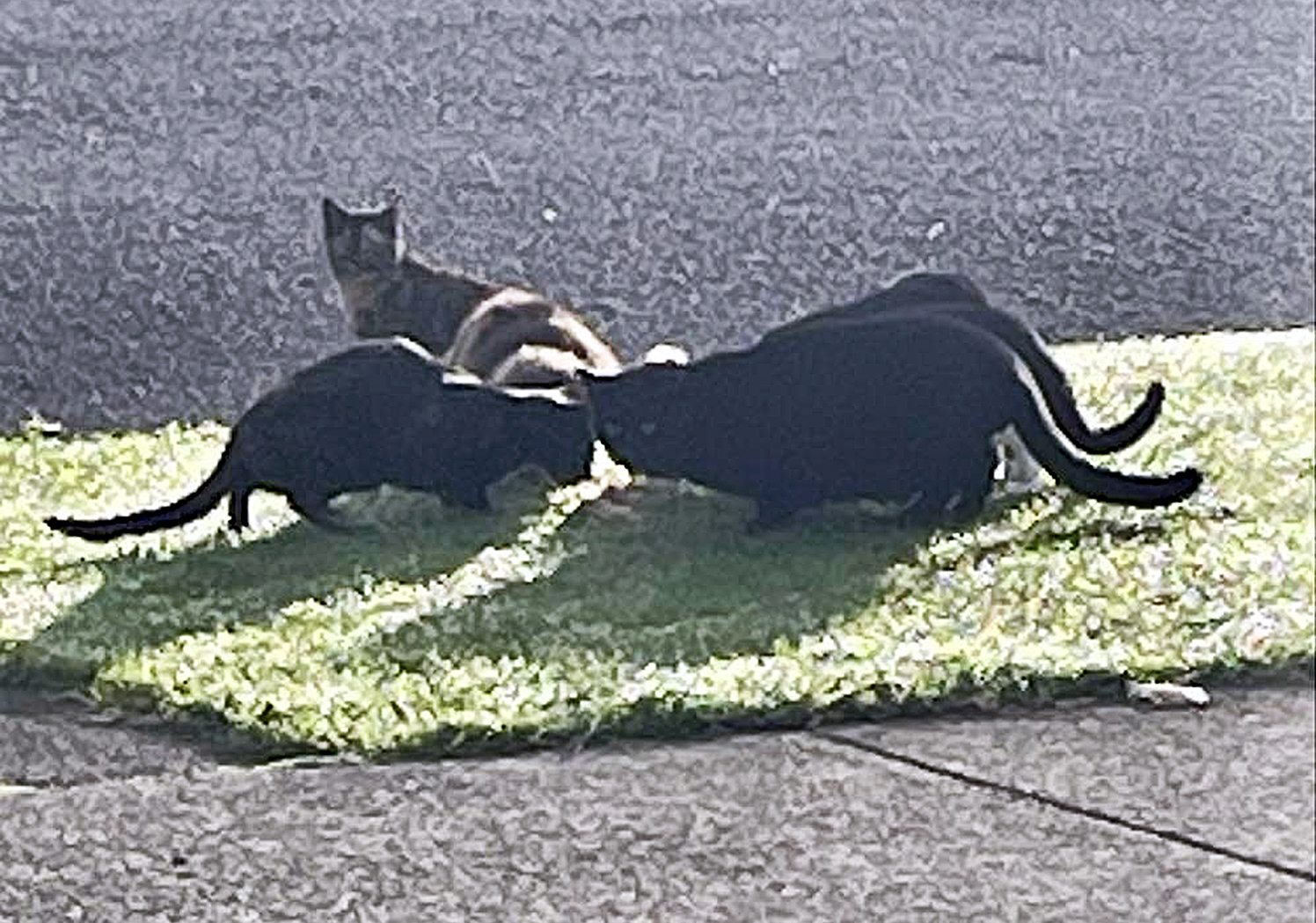
STRAYS SWARM: Stray cats on Pohutu Street gather for feeding each evening, with a resident having taken pity on the hungry felines.
Alisha McLennan
Stray cats have become the scourge of Pohutu Street in Whakatāne, digging up gardens, pooping on lawns and even shredding the occasional curtain.
Along this street, eight to 10 homeless felines can be seen perched on garden fences, curled up under the shade of letterboxes, or sunbathing together on the black roof of a boatshed.
A resident has taken pity on the cats and has been feeding them, resulting in the cats swarming on one section each evening.
A neighbour who did not want to be named told the Beacon that in the few years she had lived on the street, there had always been a problem with stray cats.
“My own cat used to chase them away, but when I lost her, they started coming onto my property,” she said.
“I wouldn’t mind getting another cat – but I don’t want to get one with all these strays around.
“They’re pooing all over the lawn – not just in the garden. I don’t dislike cats, but I do dislike picking up poo on my lawn.”
The woman said the problem worsened after the departure of a Kāinga Ora tenant living across the road.
She suspects the man had been feeding the cats, and when he left, they began scouring the street looking for alternative food sources.
“We were told he took his two cats, and the others were strays,” she said.
She said when the cats were sprayed with water to deter them, they would run to the Kāinga Ora property.
“If Kāinga Ora want to redo that property, they are going to have to get rid of the cats.”
Residents say they have contacted Whakatāne District Council, the SPCA and Kāinga Ora for support but little has been forthcoming, with the organisations citing a lack of jurisdiction, resources, and funding.
“We are looking for solutions. We’ve tried all the things that we know of,” the woman said
She said she talked to a mum on the street whose child was allergic to the cats that were prowling their property.
“She said she has plants supposed to deter cats, but it doesn’t work. One cat found its way inside and went berserk when she was trying to get it out of her house.”
Another neighbour told the Beacon he had found stray cats inside his house, climbing and ripping up his curtains.
He has teamed up with the SPCA to trap the cats, but as a welfare organisation the SPCA can accept only stray cats that are pregnant, sick or injured, meaning the man must release any healthy cats he traps, back onto the street.
“I spent all morning chasing them, trying to catch them. I caught five this morning, and I had to release all but one,” he said.
“It’s all very well taking the sick ones in, but what do we do with the healthy ones?
“You do feel sorry for them. It’s unfair on the cats and it’s unfair on the neighbours.”
Whakatāne SPCA manager Rowena Parfitt said the centre has had calls, not only from Pohutu Street about these issues, but a similar stray cat situation involving another Kainga Ora house on a different street.
“Obviously these instances are similar, but this is not an issue isolated to Kainga Ora properties,” she said.
She said the Whakatāne SPCA had a meeting scheduled with Kainga Ora in the coming weeks to develop a better understanding of its practices and procedures, and to see how the SPCA could support it in preventing these situations from developing.
Feeding stray cats should be avoided, she said, unless people were willing to take them on as their pets.
“When you feed a stray cat, you can give the mums-to-be food and sustenance to produce more babies. You can be making an animal dependent on you.
“We are a country of animal lovers; when we see an animal hungry, it can be quite distressing.
“Collectively, if everyone didn’t feed stray cats, we would have smaller litters and fewer births.
“A cat is not going to starve itself to stay on your property.”
She said although the SPCA had traps, trapping needed to be done responsibly and could be more effective with help from willing members of the community.
“We are working with a lovely gentleman on Pohutu Street. He has brought in two cats so far that were very unwell.”
One cat had a ruptured eye, and the other had several health issues.
For those wanting to take on stray cats as their own, but facing financial difficulty, she said the SPCA, in some cases could help with the cost of desexing.
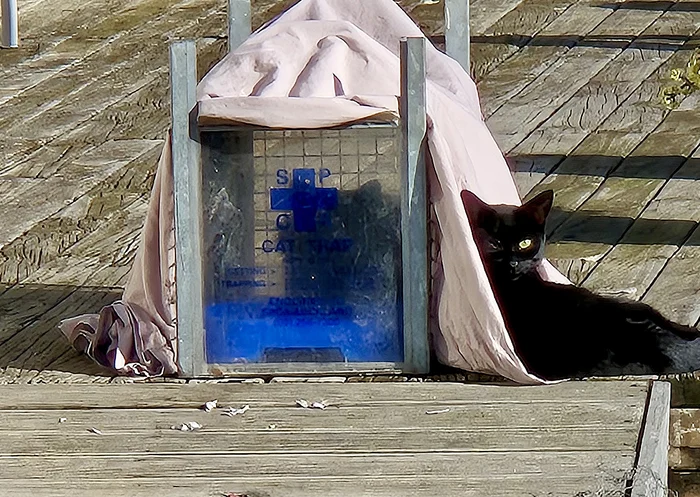
Another result of trapping can be the Trap-Neuter-Return (TNR) method of controlling stray cats. As the name implies, the method involves trapping and neutering a stray, then releasing it back into its same environment.
These cats are then treated as community cats. They cannot breed, but they can take up territory to stop other stray cats from moving into the area.
“There are studies showing this can be the best way to control cat populations. However, it would require a member of the community to put their hand up to be a “guardian” of that cat.
“If the cat became sick or injured, they would be responsible for taking it to the vet. If we are releasing cats, we have got to do it responsibly.”
She said the SPCA was very different now than it was prior to Covid.
“We understand the frustration. Since Covid there has been an explosion in the number of animals in the community.
“We are now overwhelmed with the sick, injured and vulnerable cats. We are a welfare organisation, so our priority is to take care of the sick, neglected and abused animals in our care.
“We are often at capacity, as are many of our other centres across the country.”
A lack of national legislation governing domestic cat control limits what local councils can do about cat populations.
Acting manager of community regulation Mike Mackenzie said the Whakatāne District Council, along with other councils around the country, had no legal authority to impound or have control over where domestic cats roam.
“Unlike dogs, which are covered by the Dog Control Act 1996, there is no equivalent Cat Management Act.”
He recommends contacting the SPCA for advice around stray cat concerns.
“They may be able to offer guidance on management, desexing and rehoming, however, they are not obligated to accept or euthanise stray cats unless the animal is suffering.
“People can also reach out to Whakatāne Kiwi Trust if a feral cat poses a threat to native wildlife, as they run predator control programmes that include humane trapping of feral cats.”
A Kāinga Ora spokesperson said tenants were permitted to keep pets, provided they obtained consent from Kāinga Ora prior.
“This is outlined in their tenancy agreement and allows us to make sure that the property is suitable.
“Tenants must also agree to follow local council bylaws and to take responsibility for the health and wellbeing of their pet.”
They said Kāinga Ora was not responsible for animal control but had steps it could take as landlord of the property, including requiring a tenant to rehome an animal or, in severe cases, applying to end the tenancy.
Policy changes around Kāinga Ora’s approach to pets are expected later this year.
“If people have any concerns about an animal’s welfare, they should contact the SPCA in the first instance.”
“We encourage anyone who has concerns about a Kāinga Ora property to get in touch with us directly, so we can take a look into what’s happening.”
Kāinga Ora’s customer support team can be contacted on 0800 801 601.
Deterrent strategies
People wanting to deter stray cats from their property can use humane methods such as physical barriers, removing attractants such as food left outside, sand boxes or freshly turned soil, unsecured rubbish bins and rodent populations.
Pet cats that are not desexed can also be an attractant for a stray cat on a property and can contribute to the growing population of stray cats and kittens in an area.
Chemical barriers such as coffee grounds or sprays that can be purchased from Bunnings or pet supply stores can be used to keep cats out but, according to the SPCA website, these have mixed results.
Motion-activated sprinklers, ultrasonic devices or microchip activated cat doors are also options.
The SPCA recommends people take steps to check if a cat is a stray before acting.
There was an incident recently where the same “stray” cat was brought into the centre twice, two weeks in a row, by two different people. The cat’s owner lived one street away.
This can be done via sharing photos on community Facebook pages, using a paper collar asking the owner of the pet to call you, or asking neighbours for information.