
Kiwi deaths a blow in EBOP
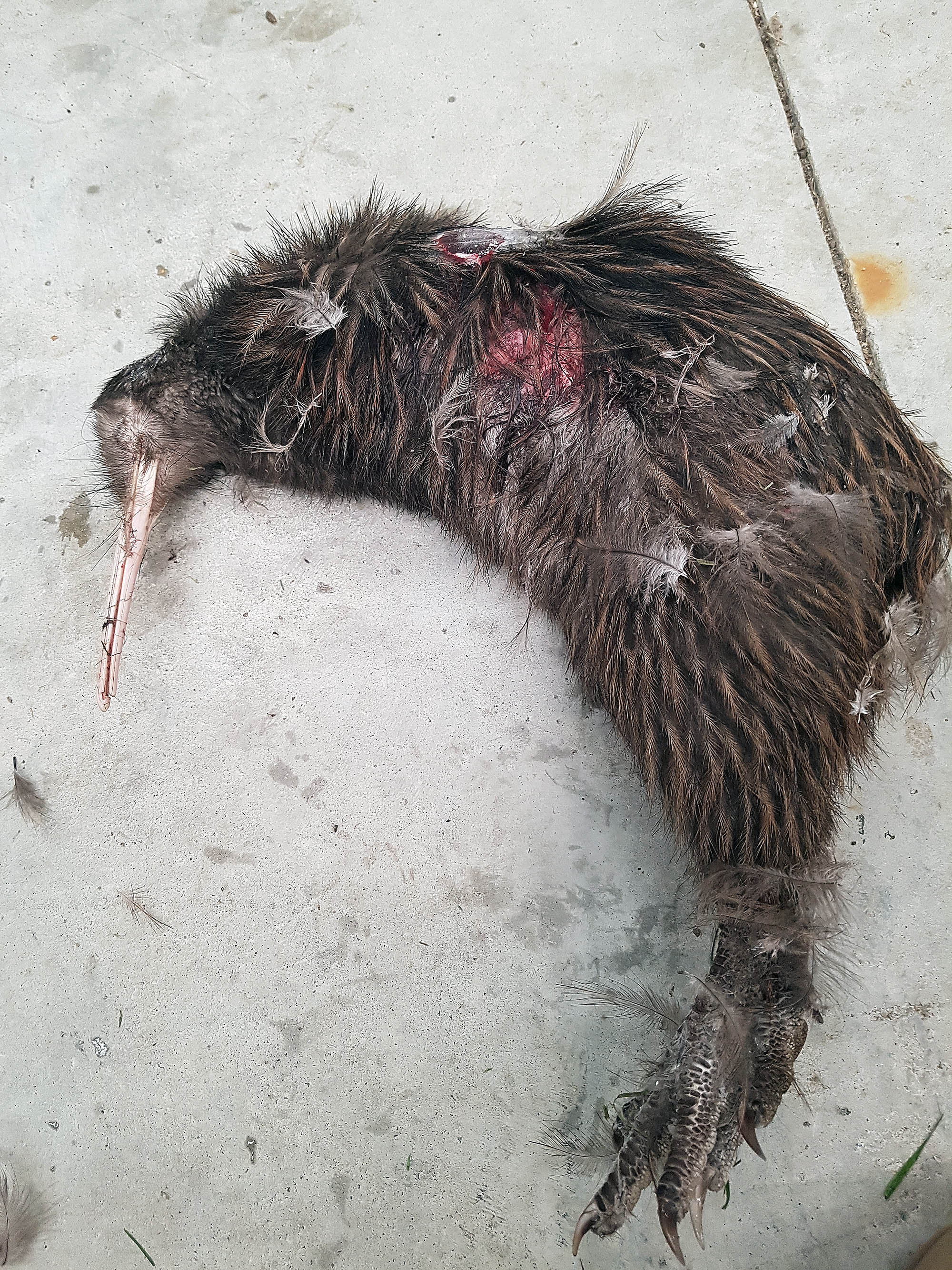
DOG ATTACK: The mauled adult male kiwi found dead near Ōhope Beach School in May 2023. Photo supplied
.
We love sharing positive updates from our kiwi conservation efforts, but restoring a sustainable kiwi population in Whakatāne is not always smooth sailing. In this article, we share some of the losses suffered by the project over the past year.
Last season, we lost five local kiwi to preventable deaths – a heavy blow to the many volunteers and contractors who dedicate their time, skills, and energy to protecting these taonga. Although the causes of death were from well-known threats, making them no surprise to the team, it is heartbreaking that we were unable to prevent them despite our best efforts.
First loss: A tragic roadside discovery
The first kiwi death occurred near Ōtarawairere Village, where a resident discovered a dead kiwi beside the road during her morning walk. Microchip identification confirmed the bird as a seven-month-old female, the offspring of well-known Kohi Point kiwi father Whiuwhiu.
The Whakatāne Kiwi Trust had monitored this chick since she hatched in October. She had successfully survived in the bush on her own during the vulnerable first six months and reached a healthy weight of 1100 grams. At this milestone, her final health check showed she was thriving, so we removed her transmitter, hoping for a long, healthy life. It was devastating to have to identify her body so soon after.
A necropsy at Massey University’s Wildbase Hospital revealed the direct cause of death was being clipped by a car. However, the underlying cause was a severe infection from a parasitic worm that had reached her lungs and brain, affecting her coordination and slowing her reactions. These worms, known as visceral larval migrans, originate from cat feaces—often from unowned or feral cats. Alarmingly, this parasite can also infect domestic cats and humans, posing particular risks for pregnant women. This highlights the urgent need for our community to actively manage both feral and domestic cats, as neither belong in our ngahere.
Second loss: A stoat or cat attack
The same weekend, another young kiwi was found predated. This chick had hatched and been raised at the National Kiwi Hatchery in Rotorua before being returned home after reaching 1000g – the weight at which kiwi are usually large enough to fend off stoats.
Blessed by Ngāti Awa kaumātua Mac Kingi and Charlie Bluett, she was named Te Hiku o te Tuna, meaning “the tail of the eel”, after the stream in her home area. Tragically, she never had a chance to thrive. Kiwi management team leader Claire Travers believes her death was caused by either a stoat or a cat. However, there was so little left of her remains that confirming the exact predator was impossible.
Third Loss: A stoat’s prey
Another hatchery chick, Mihi Marino, was released as a healthy young kiwi into the bush behind Ōhope Beach School. Her release was filled with hope, love, and excitement from those eager to monitor her progress.
Just two weeks later, when the team set out for a routine health check, they expected to find a sleeping Mihi Marino. Instead, they discovered her freshly predated remains stashed in a stoat den.
These deaths highlight the persistent threat posed by predators in the area, despite our extensive trapping efforts.
“It’s not just these three kiwi we have lost, but the future generations of kiwi they would have produced,” said Ms Travers. “All the hard work that went into getting them to this stage, and in an instant, it’s gone.”
Our trapping program removed 49 stoats this year, yet experts warn that we likely have a small but cunning population of “trap-shy” stoats — a common challenge in long-term predator control programs. Trap-shy stoats are those that survive their first year, learn to avoid traps, and pass this knowledge to their offspring, making future control efforts even harder.
Fourth and fifth losses: Dog attacks
In August, a wild kiwi (with no microchip) was found by a roading engineer. All indicators pointed to a dog attack. December saw yet another kiwi loss which was definitely a dog attack. Dogs pose a major threat to kiwi, weka, and nesting shorebirds because they can kill both young and adult birds. For some dogs, killing can become a repeated behavior. We have seen too many cases where a single uncontrolled dog has devastated a kiwi population. The aforementioned kiwi deaths are only those that we have found, we will never know the true number of kiwi that were killed by these dogs.
These attacks reinforce the need for responsible dog ownership. We urge dog owners to:
✅ Keep dogs on a leash near bush or reserves—kiwi may be asleep under ferns, and weka may be foraging nearby.
✅ Respect nesting shorebird areasand avoid disturbing them.
✅ Ensure properties are securely fenced to prevent dogs from roaming.
If a dog kills a protected native bird, its owner can be prosecuted and face a hefty fine.
Weka Killed by a Dog
Even though we are called the Whakatāne Kiwi Trust, our mission extends beyond kiwi. That’s why it was heartbreaking for our team to learn that a weka was killed by a dog along West End Road in 2024.
This attack happened during the day, when an off-leash dog, out of its owner’s control, killed the weka in a resident’s garden. Like kiwi, weka are a protected species and are equally vulnerable to dog attacks. Though it may be hard to believe in our town, there are actually fewer weka than kiwi across Aotearoa.
A Call for Community Support
While these stories are heartbreaking, we share them to raise awareness and advocate for our cause. We are incredibly proud of our volunteers and contractors who work tirelessly to prevent these deaths.
However, protecting kiwi, weka, and other native wildlife is an ongoing challenge that requires community support. There is no silver bullet for pest control, but we are committed to adapting our techniques and using all available methods to create a safe environment where native species can thrive.
Our next article will focus on how cat and dog owners can support our conservation efforts.