
Jack makes hikoi for Māori wards
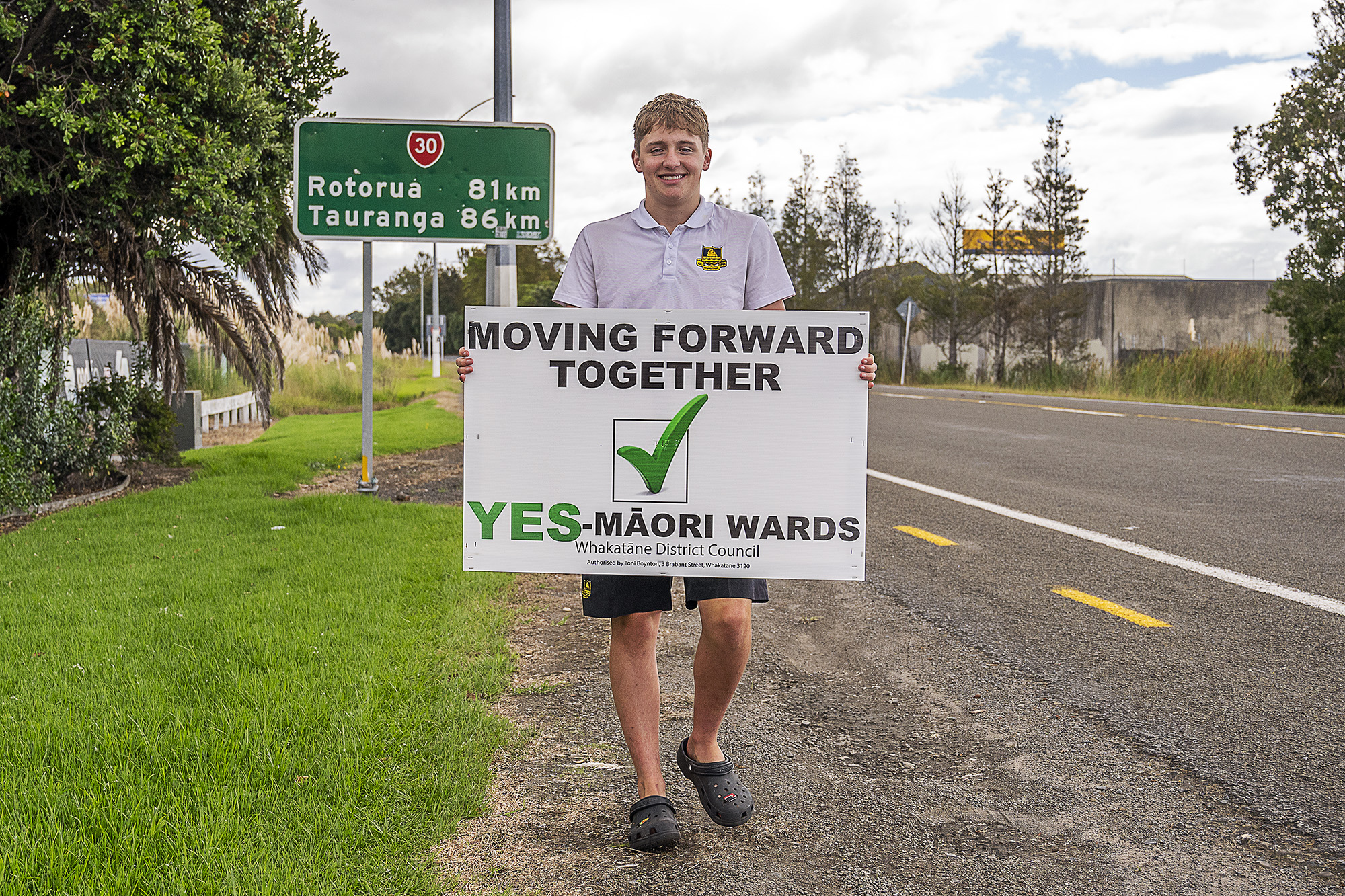
TICK YES: Jack Karetai-Barrett plans to walk from Whakatāne to Mount Maunganui next week to campaign for people to tick yes for Māori wards. Photo Troy Baker E5343-39
Diane McCarthy
Fifteen-year-old Jack Karetai-Barrett is planning a four-day hikoi from Whakatāne to Mount Maunganui and back to urge people to vote “yes” to Māori wards.
“By taking this hikoi, I’m making sure that what matters to me for the future really counts,” Jack told the Beacon.
The year 11 Whakatāne High School student is no stranger to political activism, having been embroiled in the movement to have Māori wards installed on local government councils since he was 10 years old.
In 2020, he and his mother, Māwera Karetai, travelled from Whakatāne to Wellington with Te Rōpū Tautoko Māori member Toni Boynton to deliver a petition in support of legislation changes that would allow councils to form Māori wards without voters being able to petition for a referendum.
It was young Jack who was selected from the group to hand the kete full of signatures to Minister for Local Government Nanaia Mahuta on the steps of Parliament.
“That kete still hangs on a wall in our home as a daily reminder,” he said.
The legislation brought in by the Labour Government subsequent to that event was reversed last year by the current Government, meaning councils that have instated Māori wards without holding a referendum must either disestablish them or hold a referendum at this year’s local body elections.
Whakatāne District Council, which has three Māori ward councillors opted to hold a referendum which will be binding for the 2028 and 2031 local body elections.
Starting on Monday, April 14, Jack will spend two days walking along the roadside toward Tauranga wearing a big green tick on his backpack to urge people to vote “yes” to Māori wards. After a day spent resting, he will spend the next two days walking back to Whakatāne.
He said he selected the hikoi route because it was a road he was familiar with.
“I know the road quite well, I know places I can stop and get food,” he said.
Although Tauranga City Council has no election this year, the Western Bay of Plenty District Council, which part of his walk will carry him through, will also hold a referendum on whether to retain Māori wards at this year’s local body elections.
He is happy for others who feel strongly about Māori wards to join him in the hikoi, even if it is only for part of it. However, he has no problem with walking the route by himself.
He has set up a Facebook group, “Walk for wards,” through which anyone interested could stay updated.
He has already been contacted by someone in Wainuiomata who has been inspired by him to make a similar walk in her region.
Jack said Māori wards were important because Māori voter turnout tended to be lower than the general population.
“Therefore, any Māori candidates standing in the general seats can’t get enough votes.
“This isn't because Māori don’t care about politics, but rather due to a deep-seated mistrust in the systems that have been used against Māori for so long. Many feel that voting doesn’t lead to real change, as decisions are often made without truly considering Māori perspectives.”
Supporters of Māori wards say they are essential for councils to uphold the principles of the Treaty of Waitangi.
Jack is also one of the hundreds of thousands of submitters to the Treaty Principles Bill.